An unhappy client accused their SEO agency of delivering nothing. The agency fought back publicly, turning a single complaint into a viral thread and a permanent search result. Then an independent look at the actual work found something more interesting than the fight: both sides were half right. The client's reviews were real, earned one job at a time. So was the neglect, the agency's work it was paid for, and the client's homework that would have caught it. It is a small story, and it carries two lessons that don’t often travel together, one about how to handle a complaint and one about what a reputation foundation actually is.
The Client Blowup
The setup is familiar. A home service business in a major West Coast metro, with a genuinely elite reputation, hundreds of five-star reviews, and a domain two decades old, went public with a complaint that months of local SEO and roughly $19,000 in spend had produced no new calls. The agency, a prominent local SEO shop, was doing a great job to drive leads at the top of their own funnel as the experts, aka two talking heads on YouTube, responded publicly rather than privately. In its response, the head of sales listed what it had delivered and noted, as a point of pride, that the client had filed a chargeback and that the agency had won. The dollar figures did not match: a nineteen-thousand-dollar claim by the client's telling against a twelve-thousand-dollar chargeback by the agency's, and the gap is worth a sentence rather than an accusation. A second client turned up to defend the agency with a growth chart. Other unhappy and unverified clients chimed in as well. The exchange jumped to a large SEO subreddit, where practitioners spent close to a hundred comments tearing it apart. What had been one client's bad month was now, permanently, the first thing many people would find about the agency.
A Market Everyone is Selling to
It helps to share the landscape. Home services is one of the most heavily courted markets in the country right now, because institutional capital has figured out that boring, non-deferrable trades throw off exactly what investors want: predictable demand, recurring revenue, and thousands of small, fragmented businesses to buy. The scale of it is easy to underestimate until you see the checks. In September 2026, KKR agreed to buy a residential garage-door repair company for about two billion dollars, one of several such deals, after Oak Hill Capital paid more than eight hundred million for another garage-door group earlier in the year. When a firm that manages hundreds of billions writes a two-billion-dollar check for garage-door repair, the calculus of the whole sector has shifted.
The reason is fragmentation. McKinsey's research on the roughly seven-hundred-billion-dollar market found that independents and local operators still hold more than eighty percent of it across many categories, and that in the critical, rare trades, true independents alone account for seventy-six percent. That is the roll-up dream: a huge, sticky market with no dominant national player, ripe for buying one platform and bolting hundreds of local shops onto it. Which leaves the independent operator, the family business with the twenty-year domain and the wall of five-star reviews, in a squeeze, stuck running the same playbook on repeat, or trying to level up fast enough to compete with better-capitalized consolidators that outspend it many times over on marketing. Around that operator swarms everyone selling a way out: SEO shops, AI-visibility vendors, review-management platforms, CRM sellers, operations consultants, and YouTube gurus, each promising to be the lever that changes everything. It is exactly the buyer most likely to close a deal in the DMs and least equipped to check the work afterward.
The measurement war
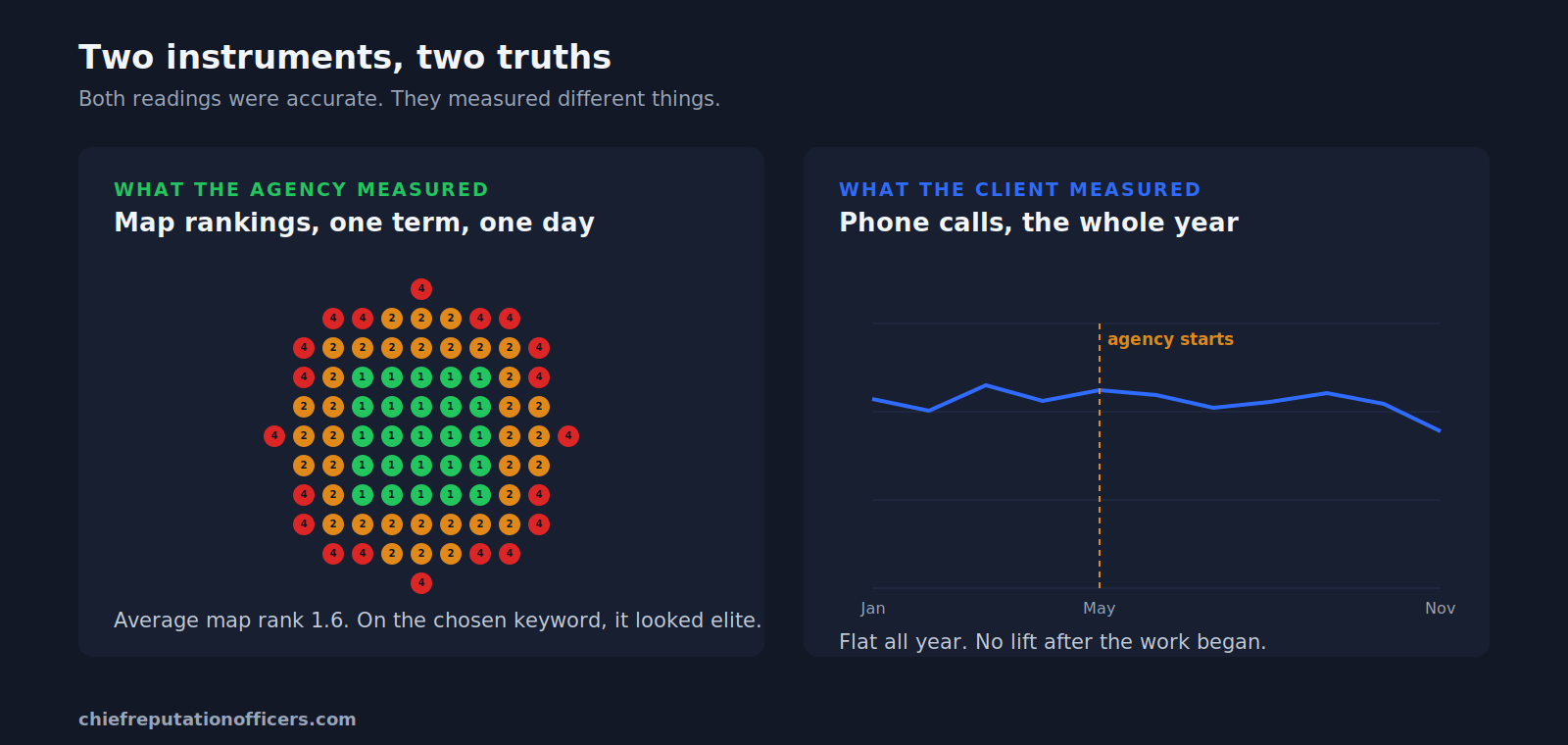
Strip out the heat, and the dispute is a measurement problem. Each side was holding a different instrument, and each instrument was telling the truth about something narrow. The agency's proof was a set of geo-grid scans, map-pack rankings for chosen search terms, captured on a single day in November, and they looked strong. The client's proof was a call log for the full year, and the phone volume was flat, with no lift after the agency started in the spring. An independent teardown, run ten months later, measured a third thing entirely: what the website declares in its code and what Google indexes for it now. All three readings can be accurate at once. Rankings improved on the agency's terms. Calls did not move. And the site's connective layer was broken the whole time. Every SEO dispute is a measurement dispute that waited too long to define the metric.
The five-star business Google ignores
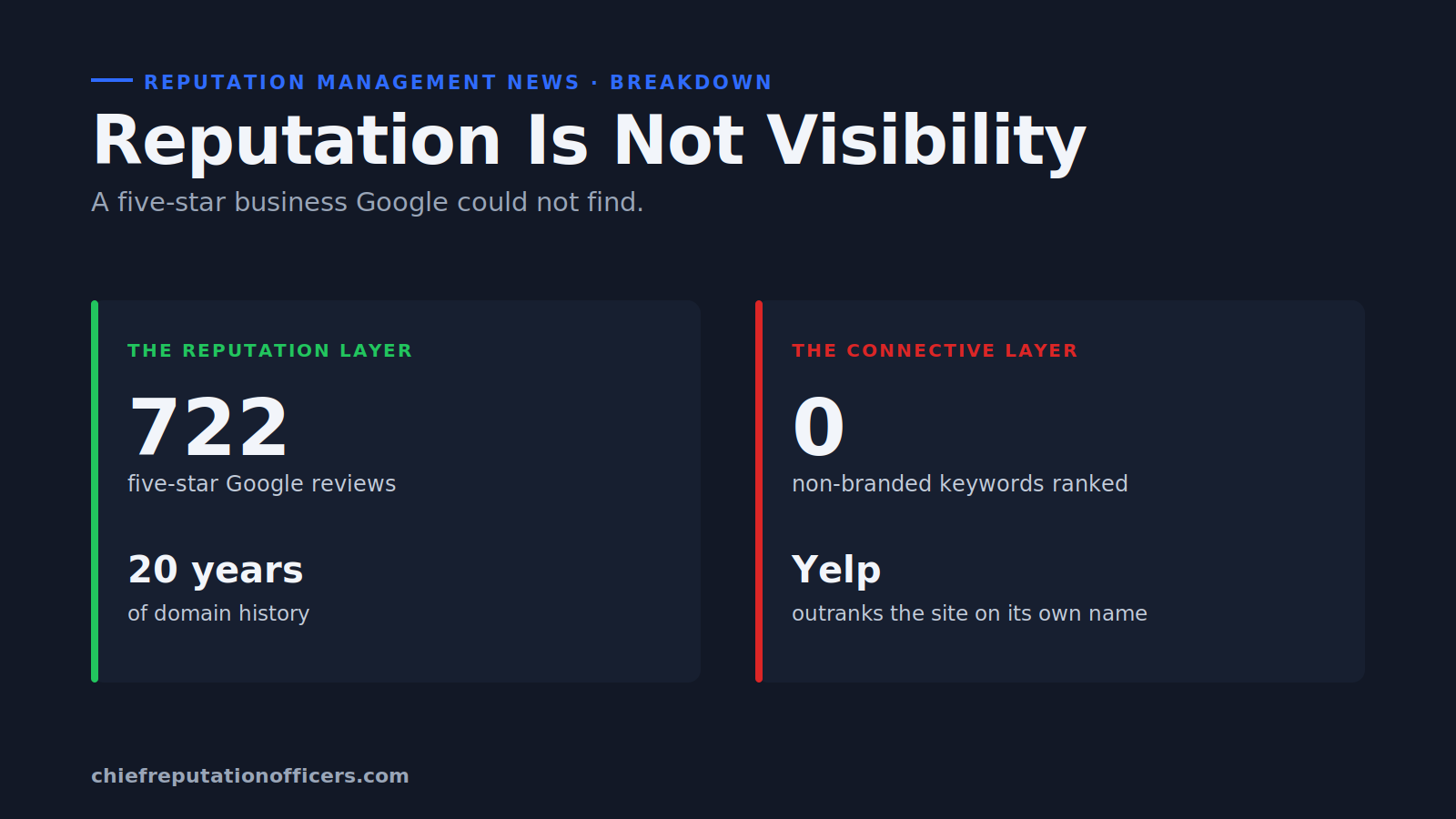
Here is the paradox the teardown found at the top. Two business profiles with more than 705 five-star Google reviews between them. A Yelp page near five stars. And underneath all of it, on a twenty-year-old domain, zero non-branded organic keywords, with the Yelp listing outranking the company's own website on the company's own name. A business almost no one could find unless they already knew to look for it.
The reasons were not subtle, and each was checkable in minutes. The primary category on the main profile was set to the wrong business type. The two profiles disagreed on basic facts, including hours. The site's structured data had been abandoned mid-build, with empty or null fields where the description and location should be, no links tying the business's own profiles together, and only one of the two locations marked up at all. The review badges on the site advertised counts higher than the live totals, stale trust numbers that quietly undercut the trust they were meant to project. And a lookalike site under the brand's own name held a top-three spot in branded search, complete with an out-of-area phone number and stock-photo testimonials. None of this is exotic. It is the connective layer that turns a good reputation into a findable business, and it was simply never built.
The location pages
The centerpiece was ten city pages, one per town in the service area, on a clean and sensible URL structure. The architecture was fine. The content was the problem. Every page led with the same headline, the same template with one adjective rotated in, premier, experienced, reputable, dedicated, and on down a thesaurus. Compared against each other, the pages were nearly half identical. Each was, roughly, half boilerplate and half filler spun around a single stereotype of the town, premium finishes for the wealthy suburb, rural properties for the farm town, with a sliver of genuinely local content, two real sentences across thousands of words. One page cited itself as the authority for its own city's regulations. A raw string of keywords sat above the footer on every page. The county hub claimed to cover the whole county, even as a third of its towns had no page at all, and its closing line named one of the towns it had skipped. This is what lexically unique content looks like when it is built to satisfy a spinner rather than a searcher. Google had ten pages to choose from and no reason to prefer any of them.
A necessary caveat
Zero organic rankings is a signal, not a verdict, and it deserves an honest footnote. The scan landed during a stretch of ongoing search volatility, and the number alone cannot separate a site that underperforms on its own merits from one facing a manual action. Only the owner's Search Console can settle that, and this teardown did not have it. Given the state of the content, the boring explanation is the likely one: the pages underperform because they earned it. That is a very different thing from a manual action, and the difference matters.
Winning the chargeback, losing the room
Now the part an SEO agency, of all businesses, should have seen coming. A single unhappy client is a gripe, and a gripe dies quietly if no one feeds it. What turned this one into a viral thread and a first-page Reddit result was not the client. It was the agency's decision to fight in public, to list its receipts, to tout the chargeback it won, to describe difficult customers in the language of disease. That is the Streisand effect, self-administered by the one party with the most to lose from the attention. And the irony runs deeper: a firm that sells visibility spent a week building a worse first page for its own name.
There is a quieter way, and the operators who last know it. They win most chargebacks and still, now and then, refund the customer anyway, not because they were wrong but because a furious client with a keyboard can cost more than the invoice ever did, and a near-perfect rating is worth more than a twelve-thousand-dollar win. An agency with a roster of genuinely happy clients can afford to lose a battle to win the war, quietly absorbing one bad outcome rather than taxing the reputation that brought those happy clients in the first place. Announcing that you beat a customer does not prove you were right. It proves that the customer service broke down, and it advertises that the firm does not understand what it sells. It is true that you cannot scale a business by bending to every complaint. It is also true that you cannot scale one by turning your angriest customers into your loudest marketing. The rating survives on quiet resolution, not a public victory lap.
The cobbler's children
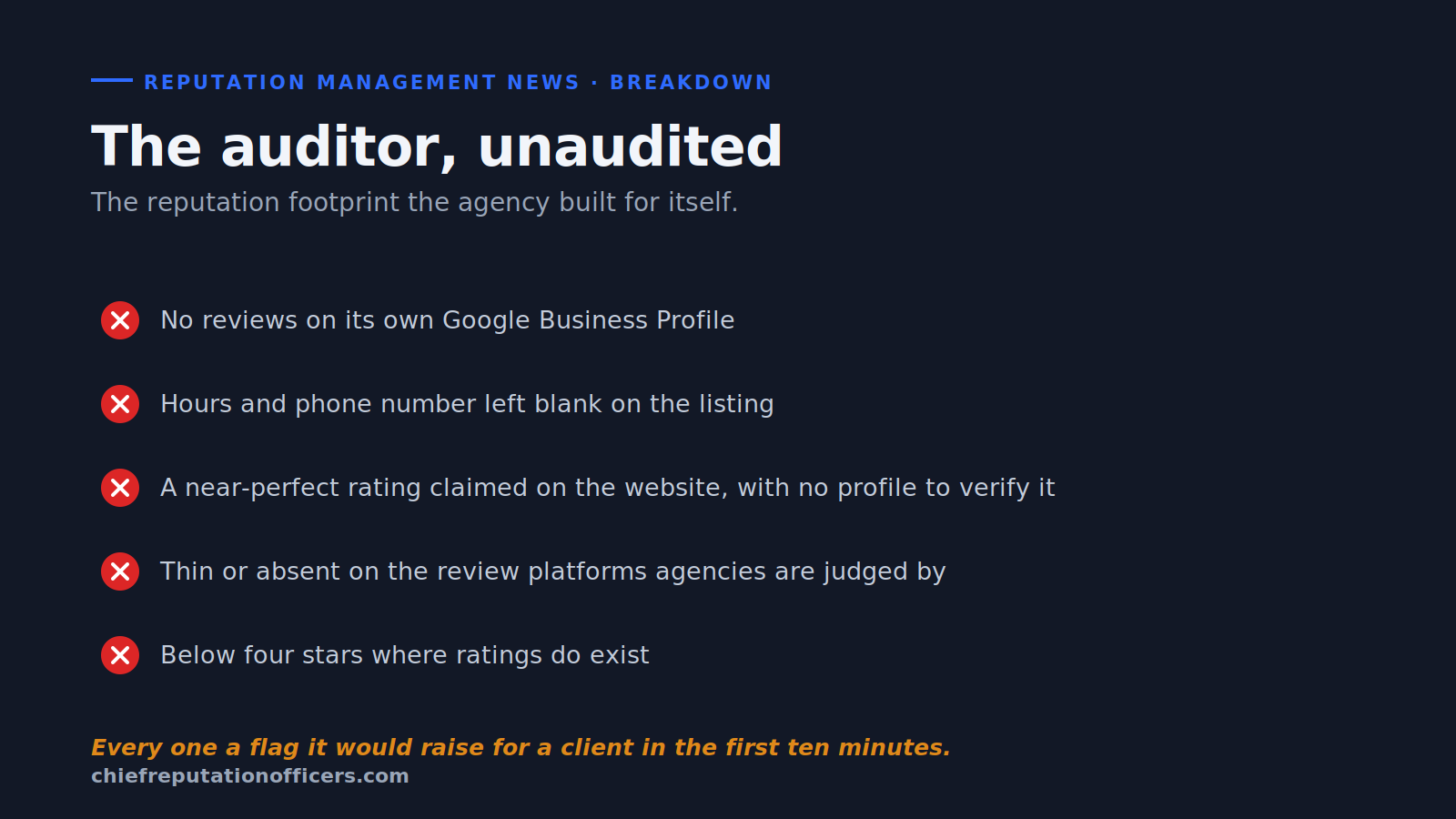
There is a quieter flag in this story: the agency's own reputation footprint. A firm that sells local search and map-pack visibility has, on its own Google Business Profile, no reviews and half the fields left blank, no hours, no phone number, the sort of listing it would flag on a client in the first ten minutes. Its site advertises a near-perfect Google rating and zero negative reviews, yet points to no profile that would verify it, and the profile that does exist carries none, the same stale-badge problem the teardown found on the client's site. On the independent platforms an agency is usually judged by, there is little to find, and where ratings exist, they sit below four stars on a handful of reviews. None of this proves the work is bad. It proves the expert never ran its own audit. The cobbler's children have no shoes, and in this trade that is the tell that matters: a reputation partner that has not tended its own reputation is showing you, in advance, how much attention yours will get.
The lessons
For buyers: a flawless profile tells you nothing on its own. Check the category, check whether the linked profiles agree, and read two of the location pages your agency built side by side before you approve the next invoice. Reviews are earned by the business; visibility is built by the vendor; one can be excellent while the other is missing entirely.
For agencies and in-house SEOs: audit your own work on the schedule you would audit a client's, because the foundation is the job. Ten pages spun from one template give a search engine nothing to choose between; ten pages built on real projects, real local detail, and schema that actually names the place give it a reason. The deeper failure started long before the public fight. No client should get seven months and five figures deep before both sides agree on what success looks like. The gap to close early is the one between the sales pitch and the deliverable: spell out what the client will and will not see, name the levers that actually move the promised number, and make sure the budget is spent pulling those levers rather than on a cookie-cutter package that maximizes the agency's margin instead of the client's result. And handle complaints as if they were marketing, because they are. How a reputation firm treats its worst day in public is the most honest ad it will ever run.
For the dispute itself, both stories can be half-true at the same time. The work existed. It just was not work that could rank. The fix was never a 10-page rewrite. It was a foundation that should have been poured before the first invoice, and a metric both sides should have agreed on before the first dollar changed hands. A five-star reputation and a findable business are two different assets. Build one and neglect the other, and you get exactly what this business got: beloved and invisible.
The frameworks this breakdown leans on live in SEO Reputation Management, Review Management, the DON'Ts of Reputation Management, Brand Reputation Management, and The CRO Role.