The seat that owns how a company is perceived is the least stable one at the table. Marketing chiefs leave their roles faster than any other executive; their average tenure is the shortest in the C-suite, and the title itself is quietly being renamed out of existence. The data says this is a churn problem. Look closer, and it is a measurement problem, and the thing going unmeasured is reputation.
This started with a recent conversation with another agency about how to sell to CMOs. It surfaced a newsletter from The CMO, flagging that marketing chiefs turn over faster than anyone else in the C-suite. A claim that sharp earns a fact check before a repost, so every figure here traces back to a named primary source. The CMO's reporting holds up, and the checking points somewhere more useful than turnover.
The numbers are not close
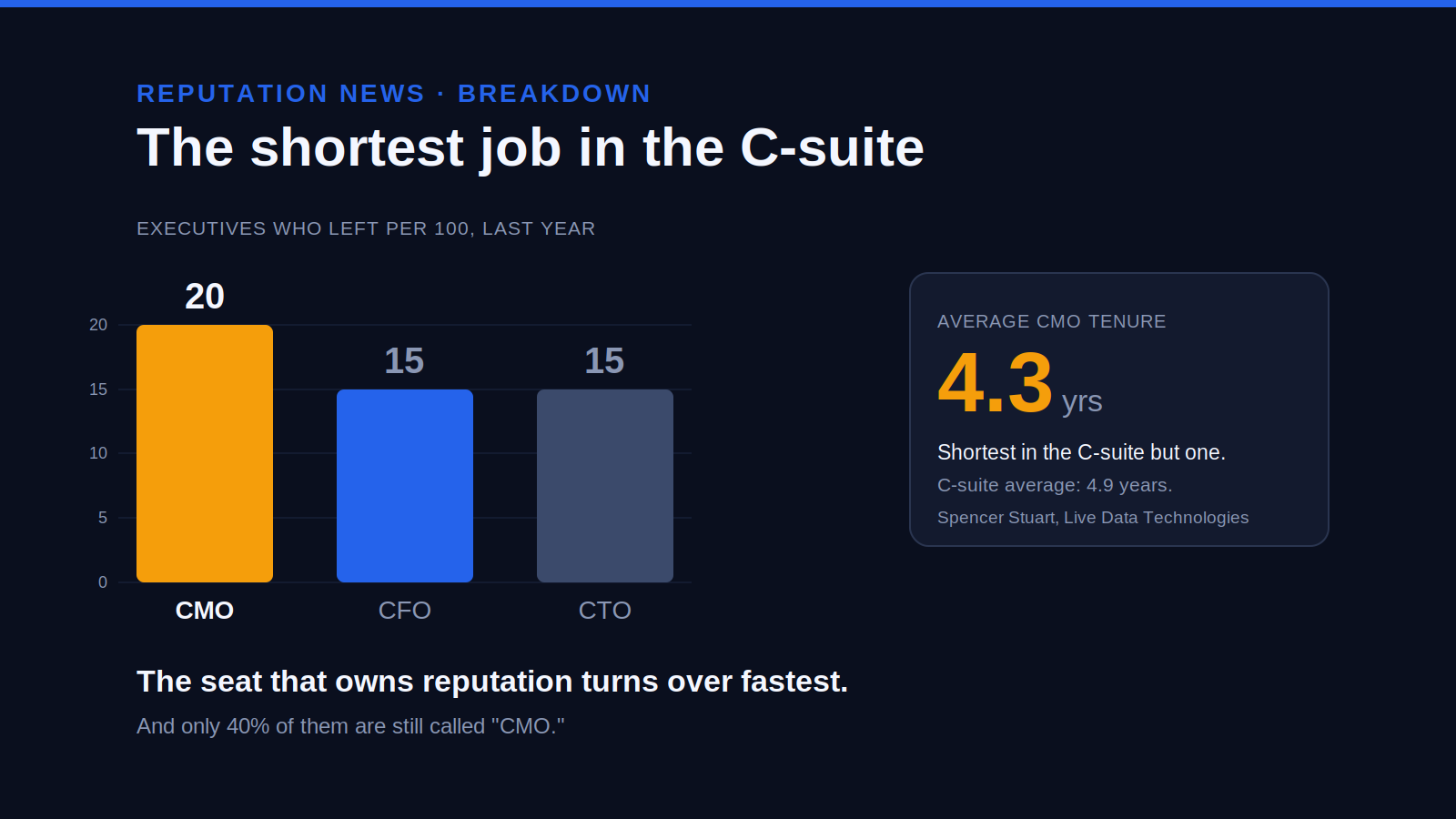
Start with the exits that have been documented. Over the past year, roughly 20 of every 100 US chief marketing officers left their jobs, compared with about 15 of every 100 chief financial and technology officers, according to Live Data Technologies. This is not a one-year blip. By the firm's count, CMOs have left faster than their finance and tech peers every year since 2019, and the gap has not closed. Early 2026 figures track the same way.
Tenure tells the same story from the other side. Spencer Stuart's 2025 study puts the average CMO tenure at Fortune 500 companies at 4.3 years, compared with a C-suite average of 4.9 years. Only the chief operating officer turns over faster. The person responsible for the brand gets less time to build it than almost anyone they sit beside.
The title is dissolving
Here is the part that should stop a marketing leader cold. The job is turning over and losing its name. In the same Spencer Stuart data, only 40 percent of Fortune 500 marketing leaders carry the title chief marketing officer. Sixteen percent have it bolted to another function, chief marketing and communications officer and the like. A third holds marketing titles without the word "chief". And 11 percent have no marketing in their title at all, surfacing instead as heads of growth, commercial, customer, or strategy.
The number of companies with a C-suite marketing leader is also declining, from 357 Fortune 500 firms in 2023 to 329 in 2024. The function is being absorbed, relabeled, and in some rooms removed. A role gets renamed when the organization is no longer sure what it is buying.
The real reason is a measurement gap
Ask why, and the honest answer is in the reporting itself. Marketing shapes how customers think and feel about a company, and tying that to revenue is hard. That one sentence is the whole problem. The CMO owns perception, and perception is the one asset in the building without a clean number next to it. When the CEO opens the quarterly review and asks every chief to defend their line, the finance chief has the ledger, the technology chief has uptime and feature ship rates, and the marketing chief has a story about brand health. Stories lose budget fights to spreadsheets. The seat that cannot price its own contribution is the seat that gets cut, and reputation is exactly that contribution.
That is why strategy clashes with the CEO so often end with the marketing chief walking. It is not that marketing is wrong more often. It is that marketing can be overruled more easily, because it arrives at the argument without the numbers to hold its ground.
Reputation is measurable now, and that changes the fight
The measurement gap is a habit, not a law. Reputation leaves a trail that can be counted. What a brand's own name returns on the first page of search is measurable. The direction and volume of its reviews is measurable. Its share of the answers that AI systems now give when buyers ask who to trust is measurable. Branded search demand, sentiment, the gap between what a company says about itself and what independent sources say, all of it can be put on a dashboard and tracked quarter over quarter.
A marketing leader who walks into the review with reputation instrumented is in a different conversation. Not "the brand feels strong," but "branded search is up nineteen percent, we hold the top answer in three of five AI engines for our category, and our review integrity moved from a liability to an asset." That is a line a CFO cannot wave away, because it is built the way a CFO builds one. The point is not to turn reputation into vanity metrics. It is to make the most valuable thing the role owns legible to the people who decide whether the role survives.
The ones who measure it get promoted
The churn data has a flip side worth naming. Not every exit is a failure. By Spencer Stuart's count, about 65 percent of departing CMOs were promoted inside their company or moved up and out to a bigger role, and one in ten stepped into a CEO seat. More than a third of Fortune 500 CEOs have marketing experience on the way up. Tenure even ticked up, from 4.2 years to 4.3.
Read together, the pattern is not that marketing leadership is doomed. It is that it splits. The leaders who make their contribution measurable rise, some of them all the way to the top. The ones who leave perception as a feeling get churned, or watch the title drift to growth and commercial while someone else inherits the mandate. The dividing line is whether reputation shows up as a number.
What this means for the function
The lesson for anyone who owns reputation, under whatever title, is to stop treating it as a soft asset defended with adjectives. The roles that survive the next reorganization will be the ones that can show, in the CEO's own language, what reputation is doing for the business and what it would cost to lose it. That is a reporting discipline, not a rebrand. Build the dashboard before the quarterly review, not after the exit interview.
The lesson
The shortest job in the C-suite is the one that owns the company's reputation, and it is short for a fixable reason. Reputation has been managed as a feeling in a room that runs on numbers. The marketing leaders who close that gap are the ones still in the room next year, and increasingly the ones running it. Measure the thing you are responsible for, or watch someone rename the chair you sit in.
The frameworks this breakdown leans on live in SEO Reputation Management, Brand Reputation Management, and Review Management. The measurement neighbors to this piece are SEO as Reputation Infrastructure and E-E-A-T and Branded Search.