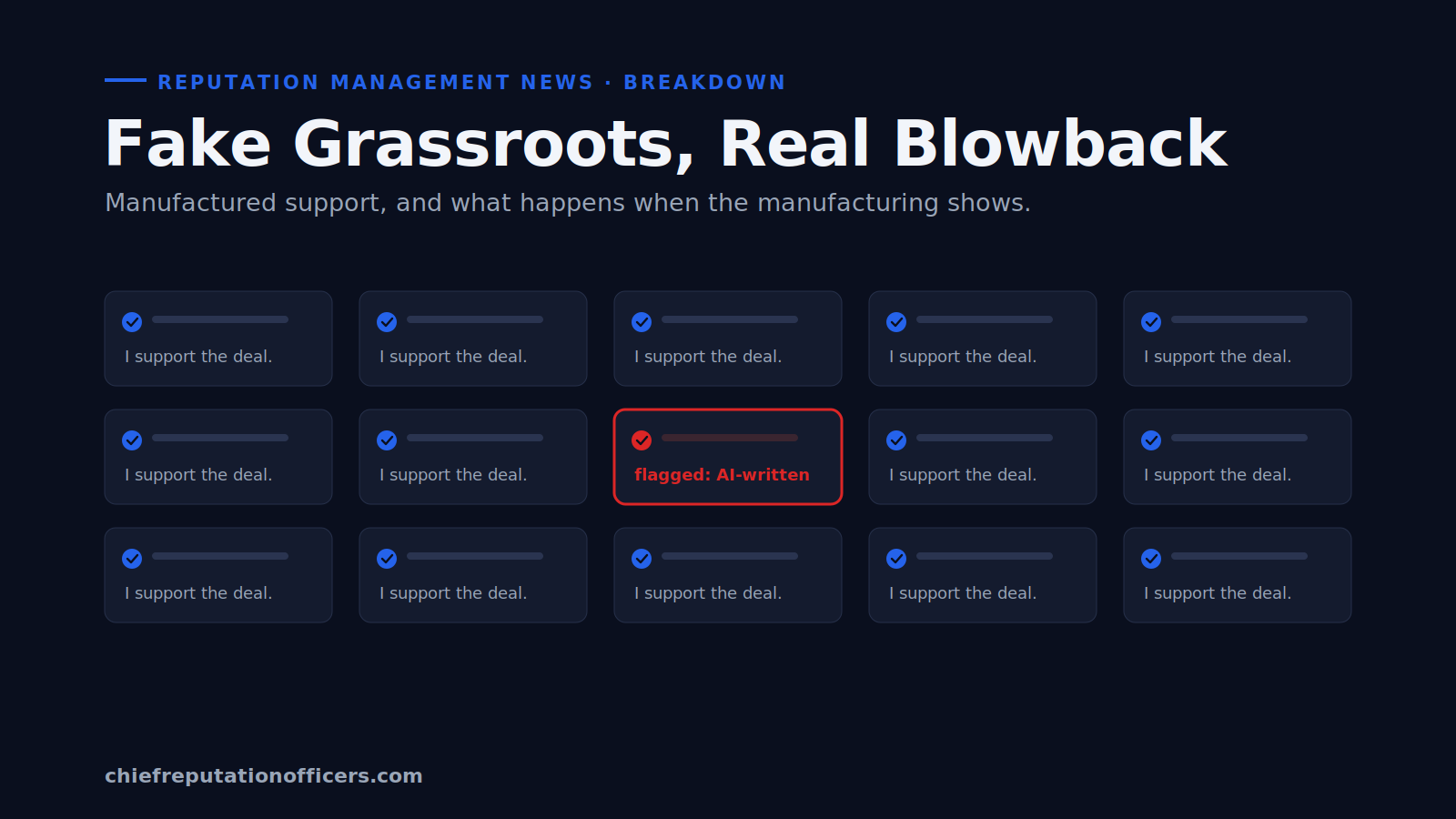
A company trying to close one of the largest media mergers in years was accused of manufacturing its own public support, and the accusation, more than any proof of who paid for it, became the story. Welcome to astroturfing in 2026, and this version came with a new machine in the loop: an AI tool that, according to one participant, replaced a real person's opposition to the deal with a fabricated letter of support. Whether or not a money trail is ever produced, the reputational damage was done the moment the pattern became visible.
What happened
The reporting is specific, and so are the denials. In August, The Intercept described a group called Neighbors for Strong Communities that was texting Californians and urging them to pressure the state attorney general, Rob Bonta, to drop his antitrust lawsuit against the Paramount and Warner Bros. Discovery merger. The group's incorporation papers list directors who have worked as political consultants. A spokesperson and director, Tanner Kelly, a registered lobbyist, rejected the astroturf label, said the campaign was operated independently of Paramount, and declined to disclose its funders. Warner Bros. Discovery denied funding the texts, and Paramount did not respond to reporters. This breakdown takes no position on the merger itself. The reputation lesson lives entirely in how the support was manufactured and what happened when that became visible.
What astroturfing is
Astroturfing is manufactured grassroots: a paid or coordinated operation dressed up as spontaneous public sentiment. It is the political and corporate cousin of the fake review. A business buys five-star reviews to fake customer love and appreciation; an interest buys a citizens' group to fake public consensus. The goal in both cases is the same: to put a thumb on a decision by making a manufactured position look like an organic one, whether that decision belongs to a shopper comparing options or an official weighing a lawsuit.
The tells
The people who study these campaigns have a checklist, and it is worth knowing because the markers rarely change. The Committee for the First Amendment, a group that has tracked this kind of thing since the 1940s, pointed to the familiar ones: an organization only a few months old, no disclosed founders, board, or funders, no presence in the databases that track real nonprofits, and a headquarters that turns out to be a mailbox at a shipping store. Add a generic, focus-grouped name and a sudden burst of identical outreach, and the shape is recognizable. None of it proves who is behind the group. All of it explains why observers assume someone is.
The machine in the loop
Here is what makes this a 2026 story rather than a rerun. The campaign reportedly ran on an AI tool built to generate personalized advocacy messages at scale, marketed, with no apparent irony, against generic astroturf form letters. One California resident wrote that the system took his public statement opposing the merger and replaced it with an AI-generated letter supporting it, submitted under his name. The group's spokesperson conceded the incident uncovered something that should not have happened and said safeguards had been strengthened. Sit with that failure mode for a moment. The previous generation of astroturf faked the volume of support. This one fabricated a specific person's position and put words in his mouth. AI lowers the cost of manufacturing sincerity and raises the ceiling on how badly it fails, because inventing or flipping a real individual's stance is not a louder version of the old problem. It is a different and worse one.
Caught fast, or caught late
Not all of this is exposed on the same clock, and the timing itself is a reputation variable. Clumsy influence aimed at a mass audience tends to get flagged quickly, because somewhere in that audience is a reporter, a rival, or a watchdog motivated to check the story, and a text blast to thousands of strangers is easy to screenshot and trace. The channel is not neutral, either, and a growing body of research documents why. Pew Research Center surveys and independent algorithm audits find that X's audience and recommendations have tilted rightward since 2022, while platforms like Reddit skew younger and more progressive. A manufactured message tends to get dismantled fastest where it runs against a platform's dominant audience and to glide where it flatters one. Reading those audiences is ordinary reputation work; it is how a practitioner decides where to speak and how, and astroturfing is simply what happens when that same audience knowledge is turned to faking the crowd instead of reaching it. The Paramount effort was flagged within weeks. More sophisticated influence, the kind run through legacy public-affairs firms and high-end PR, can operate quietly for years, precisely because it stays out of the mass channels where scrutiny concentrates, surfacing later in an investigation or a book, long after it has already done its work. For anyone weighing the tactic, the point is that exposure is rarely avoided, only delayed, and the longer manufactured influence stays buried, the larger the reckoning when it finally comes to light.
The blowback
The economics of astroturf are asymmetric, and that asymmetry is the whole lesson. If the campaign runs unnoticed, the payoff is a modest nudge toward the outcome you wanted. If it is exposed, the fakery becomes the headline, confirming the exact suspicion the opposition had already voiced: that the position could not win on its own merits and so had to be manufactured. Manufacturing, once caught, often does more damage than the opposition ever could, because it turns a policy disagreement into a credibility problem. It is a close relative of the Streisand effect: the effort to engineer a reputation produces the opposite of the intended one.
The deniability paradox
These types of covert operations are engineered for deniability. The generic name, the undisclosed funding, the arm's-length contractor structure, all of it exists so that when the accusation arrives, everyone involved can issue a clean denial and point to the absence of a paper trail. And the denials here were clean. But deniability protects the legal position, not the reputation. By the time the denials go out, the story has already shifted from "here is a case for the merger" to "here is a company accused of faking support for the merger," and that frame does not need a smoking gun to stick. You can win every denial and still lose in the court of public opinion.
The lesson
For any organization tempted by the shortcut, manufactured consensus is a fragile asset with a catastrophic failure mode. Real advocacy cannot be purchased, and the moment you are paying to fabricate it is the moment you have quietly conceded that the genuine case is not winning on its own. The tools have gotten better at imitating a real voice, and while not everyone can tell the difference, others are committed to spotting fakes. And that has not changed the underlying math. For everyone else, the readers, the officials, the reporters, the defense is the old checklist plus a fresh skepticism about suspiciously fluent enthusiasm. In 2026, the fake letters are better written and sometimes remain hidden. That said, they are still fake, and the people who run these campaigns still, eventually, have to explain who paid for the grass.
The frameworks this breakdown leans on live in Review Management, Understanding the Streisand Effect, the DON'Ts of Reputation Management, and The CRO Role.