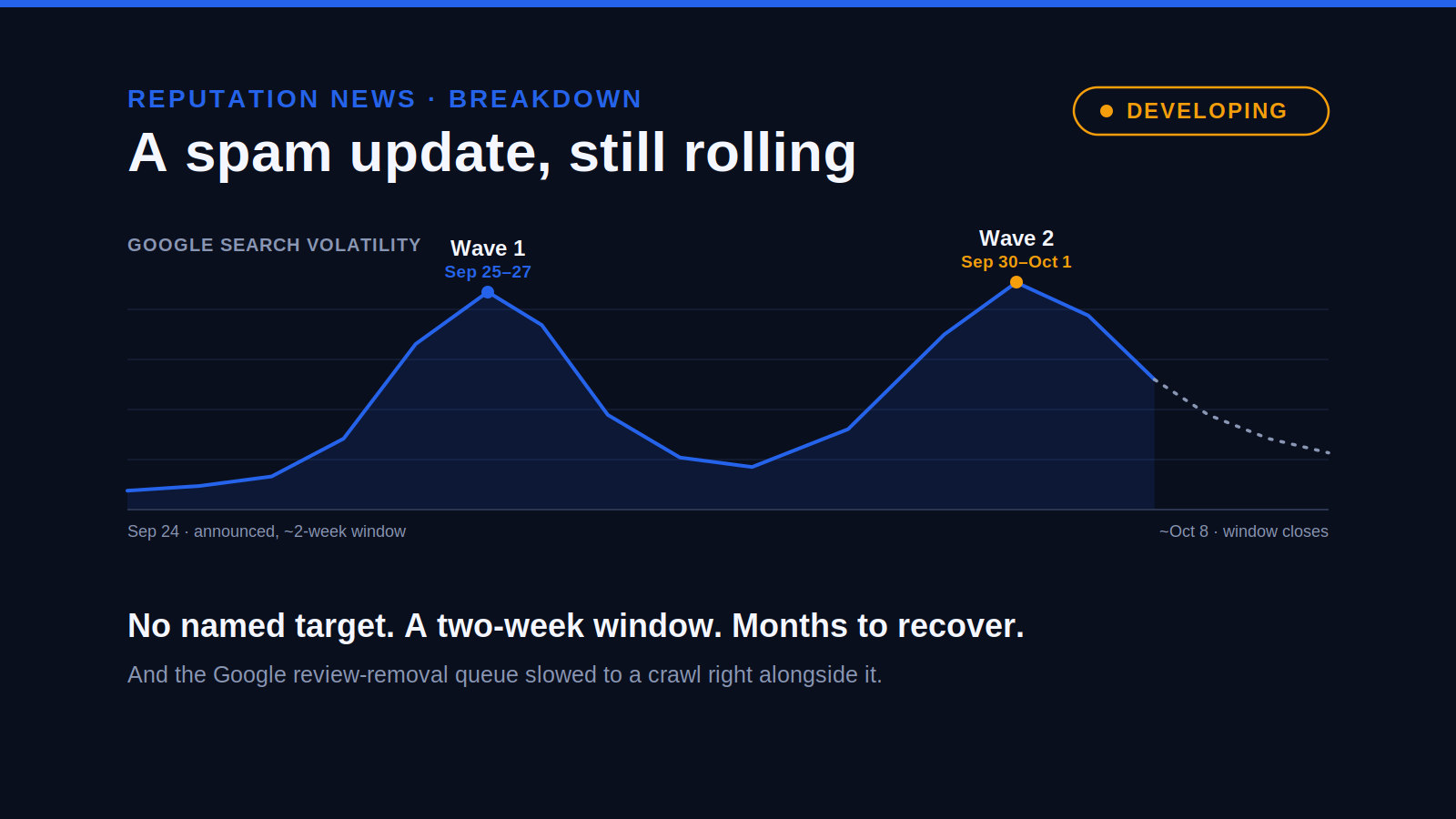
Google's September 2026 spam update is still moving two weeks after it began. The ripple practitioners feel most is not the typical drop in rankings. It is a review-removal pipeline that has slowed to a crawl.
Google confirmed the update on September 24 at around noon Eastern. The announcement carried one line that changed how the whole thing should be read. The rollout may take up to two weeks to complete, not the usual two days. Two weeks is not a slower version of the same event. It is a different kind of event, one that arrives in waves and does not settle on anyone's schedule but Google's.
The rollout came in waves, and the scoreboard is not final
The first wave hit on September 25, ran through the 27th, then cooled off. Sites that dropped and sites that held drew the same early conclusion: it was over, and they knew where they stood. They were wrong. Volatility heated back up on September 30 and into October 1, a second wave the tracking tools registered as sharply as the first. Barry Schwartz at Search Engine Roundtable logged it as phase two. Discover and News traffic swung hardest.
The takeaway is narrow and firm. Do not call the outcome while the update is still moving. A site that survived the first wave can still move in the second wave, or in a third that has not yet arrived. Google's stated window runs to roughly October 8.
Google named no target, and that is the useful signal
Every SEO blog raced to name what the update hits. Google did not. The confirmation pointed only to improved automated spam detection, the SpamBrain family of systems, and told site owners to check their pages against the full spam-policy list rather than guess.
That silence is worth more than a named target would be. Google enforces 16 spam policies, and the ones most closely tied to reputation are the familiar ones: site reputation abuse, scaled content abuse, expired-domain abuse, and link spam. When Google tightens automated detection without naming a lane, it tightens across all of them at once. The question for a reputation practitioner is not whether the update targeted them. It is which of the surfaces this work depends on just got less stable. For high-volume ORM firms, scaled content abuse and link spam are the lowest-hanging fruit.
Enforcement waves ripple into reputation surfaces
A good deal of reputation content lives on exactly the surfaces a spam update tests. Keyword-stuffed, vanity placements on contributor-mill sites are rampant. Guest posts bought in volume to push a negative result down the page. Thin articles spun up on unrelated Web 2.0 sites to fill out a brand's second page. All of it is the inventory that site reputation abuse and scaled content abuse were written to catch. When a wave moves through, that inventory is the first to dance around, and a negative result buried under purchased placements can surface again overnight when the placements temporarily above it lose their footing.
This is the quiet risk in burial as a strategy. It holds only as long as the props hold. An enforcement wave is a stress test on every prop at once.
Review removals slowed to a crawl, and the timing is hard to ignore
Here is the part no ranking recap will mention. Practitioners who file Google review removals for a living are watching success rates stall right now. Requests that used to clear in days are sitting. Removals that used to land are coming back denied, or not moving at all. The slowdown lines up, almost to the day, with the spam update's rollout.
Two things need saying plainly. Google Business Profile review moderation and web-search spam ranking are separate systems, and Google has not connected the two. So this is a correlation and a field observation, not a cause Google has confirmed. Google tends to be more vague when it comes to reviews, and hypes up the fake five-star reviews it catches and removes, not the legitimate one-star reviews that are the collateral damage. The timing is still hard to wave off. A global spam rollout concentrates Google's automated retuning and review attention in one place for weeks, and the review-removal queue is a predictable spot for the slack to show.
If review removal is part of how you earn, the move is not to push harder. Resubmitting the same request three times does not speed a queue that is backed up upstream; it flags the account and burns the credibility of a request that might have cleared on its own. File clean. Document the violation precisely, then wait out the window. A success rate that stalled in late September is far likelier to be a byproduct of the rollout than a permanent change in how Google handles reviews. If you are in that game, be patient.
Google publishes the takedowns, not the collateral
Google is not shy about the enforcement it wants seen. It reported blocking or removing more than 240 million policy-violating reviews across 2024, along with 70 million fake edits and 12 million fake Business Profiles, and credited AI for the scale. The year before, a new large language model pushed fake-review takedowns up 45% to over 170 million. Those totals sit in a public Maps transparency report Google updates on its own schedule.
Notice what the scoreboard counts. Every figure is a takedown of fake or policy-violating content, most of it the five-star spam a business would want gone. None of it runs the other way. Google does not publish how many legitimate critical reviews get swept up as collateral when the filters tighten. It does not publish how long a valid removal request takes to clear, or how those success rates move during an enforcement cycle like this one. The number that would tell a business owner what is happening to their own reviews this week is the one number Google keeps to itself. That silence is why the current slowdown can only be read from the field, not from a dashboard.
Recovery runs on Google's clock, not yours
For sites that did take a hit, the timeline belongs to Google. The company is explicit that recovery from a spam action can take months, even after the underlying problem is fixed, because the automated systems have to re-crawl the site, reassess it, and decide the correction is real. No vendor shortens that. Anyone promising a fast reversal during an active rollout is selling the same fantasy that gets sold after every core update.
What holds while the dust settles
The discipline is the same throughout. Do not call outcomes before the window closes. Do not buy a shortcut that promises to beat Google's clock. Do not resubmit a stalled removal into a backed-up queue. Document what changed and when, keep clean records of every request and every placement, and let the rollout finish before deciding what actually moved. Patience is not passivity here. It is the one position that does not make the problem worse.
The lesson
A spam update that rolls for two weeks and recovers over months is a patience test wearing an emergency's clothes. The ranking swings get the headlines. The reputation story is quieter and more useful. The surfaces this work leans on are only as stable as Google's enforcement allows, and right now Google is in the middle of a reset. Wait for the dust. Then read the board.
The frameworks this breakdown leans on live in Review Management and Brand Reputation Management.