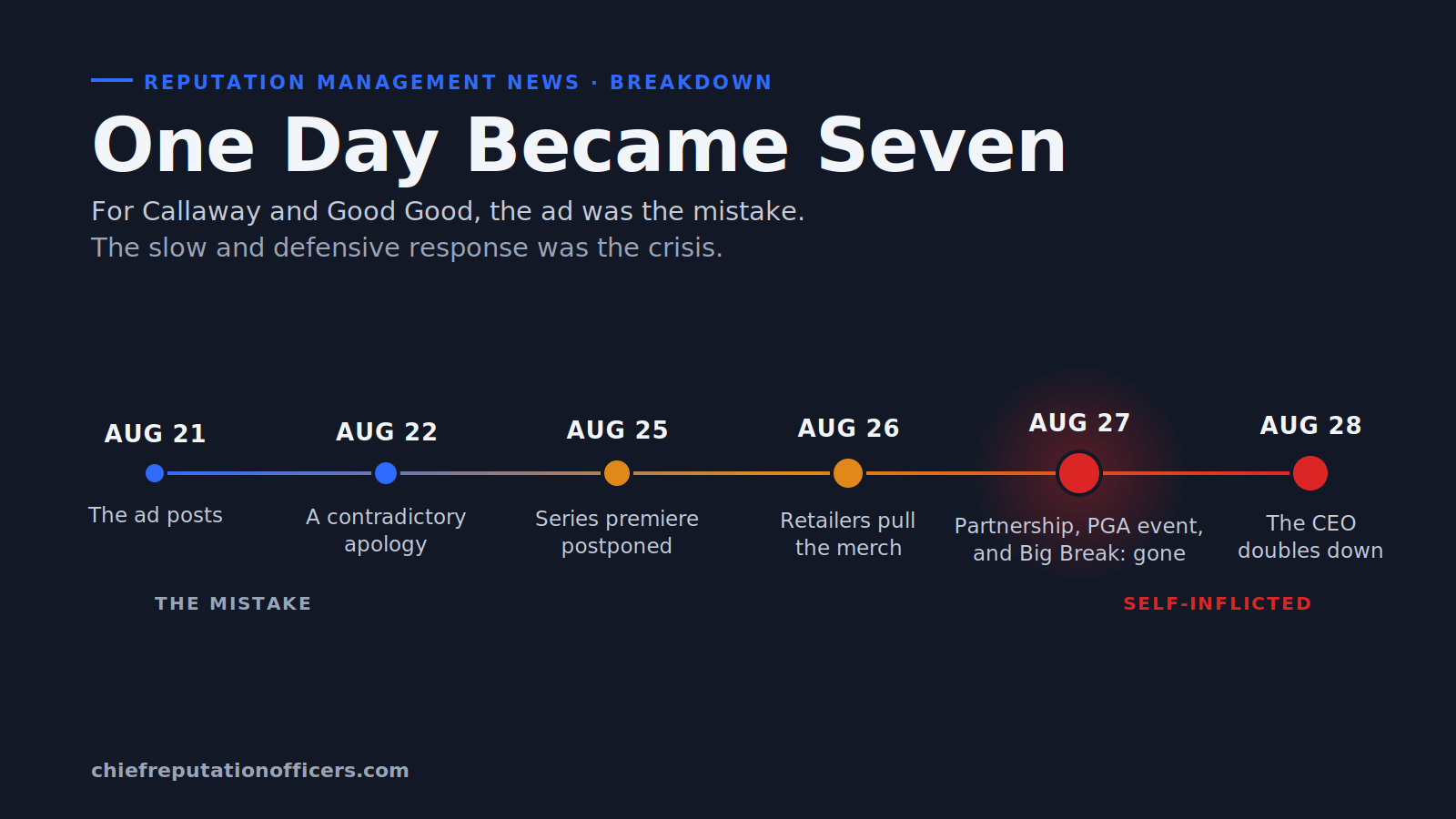
There is a rule every communicator learns early: never turn a one-day story into a two-day story. Callaway and Good Good turned a one-day story into a seven-day one, and they did most of the turning themselves. The first version of this story was about an ad. This one is about the days that followed, when the real damage was done. On Thursday, August 27, Callaway ended its three-year partnership with Good Good, committed a million dollars to organizations working to prevent violence against women, and said it had tightened its ad-approval process. Good Good stepped away as title sponsor of a PGA Tour event in Austin. That looked like the resolution. It was not. The next day, Good Good's own chief executive turned it back into a story. That is the throughline worth sitting with: this was a one-day problem that leadership kept choosing to make a seven-day one. The ad was the easy part. The response, and then the response to the response, was the crisis.
The week the response wrote the story
A bad ad can be pulled in an hour. The week of response that followed it could not. The first apology, over the weekend, contradicted itself: the company called the content misaligned with its values while its co-founder defended the full cut as a horror-movie spoof. By Wednesday, that defense had stretched into an eight-minute video. While leadership hesitated, the pressure did the escalating for them. Golf Galaxy, Dick's Sporting Goods, and Target pulled Good Good merchandise off their shelves. The PGA Tour's questions grew louder. Only then, on Thursday, did the cascade land in full. Callaway cut the partnership, pledged the donation, and outlined corrective measures; the same day, Good Good gave up its PGA Tour title sponsorship, and Golf Channel shelved the comeback season of its Big Break series, with 12 competitors caught in the collapse. Callaway's actions were the right ones. They also read as forced rather than chosen, because every day of waiting let a retailer or a partner make the decision look inevitable instead of principled. In a crisis, speed is not a nicety. It decides whether you lead the story or get dragged through it.
And then the chief executive reopened it
The resolution held for about a day. On Thursday night, instead of absorbing the outcome, Good Good's chief executive went on X and took aim at Callaway. He alleged that Callaway had approved the ad and then made Good Good take the fall, accused it of running a coordinated media blitz, framed the million-dollar donation as a way to buy its way out, and said he was not opposed to suing. As each partner exited, he found another to blame: when Golf Channel pulled Big Break, he pointed at the retailer who had walked first and agreed with supporters who cast the episode as manufactured rage that had crushed innocent competitors. Every version located the cause somewhere outside the room where the ad was made and approved. There may be a genuine business dispute buried in some of that, over who approved what and what the contract actually said. But the venue for a contract fight is a lawyer's office, not a midnight post. Airing the grievance in public, in the middle of a reputation crisis, is itself a reputation decision, and an expensive one. It re-centered the story on blame and a threatened lawsuit, bought the brand another day in the negative cycle, and contradicted the company's own statement from hours earlier about focusing on its team and learning from the situation. What the post really did was recast the company as the victim of a coordinated plot rather than the party accountable for what shipped, complete with a nod to the whole thing becoming a documentary-worthy saga someday. That is the reflex to watch for, because it is the exact inversion of what the moment asks. Accountability and a public finger-point cannot share a week. The audience was asking who was responsible. The answer it got back was them, not us.
The post that became a courtroom
One detail captured the whole failure. The original promotional post stayed up through the worst of it, and its comment section stopped being a product launch. It turned into a public accountability thread, a running, timestamped column of disgust posted directly under the company's own logo. The obvious lesson is to delete the post. That is the wrong lesson. Leaving a controversial post up can be a legitimate release valve, a place for people to vent that you do not need to sanitize. It works only when the response has earned enough credibility to hold the room. Without that credibility, the post stops being a release valve and becomes a monument. The question is never only should we take it down. It is: have we earned the right to leave it up?
The accountability era
Notice what the public was actually asking by midweek. The questions had moved past what happened to who approved it, who signed off, and what had changed since. That shift matters, because those are different questions with different answers. Callaway sat in the approval chain; this was not a rogue employee posting without permission. What helped Callaway was that it stopped saying only that it had made a mistake and moved toward something closer to an account: the CEO called the approval a failure that should never have cleared, pointed to corrective actions, and said the process had been tightened. What hurt Good Good was the opposite move a day later, trading an account for a grievance. When audiences assume a decision chain behind every misstep, an apology is table stakes. Naming what broke and who was accountable is what actually moves people.
When a brand crisis turns personal
There is a harder edge here that deserves a sober mention and nothing more. A controversy at this volume did not stay aimed at the brand. It spilled onto the individuals attached to it, the way large online pile-ons now reliably do. The lesson is not about any person's conduct, which is not this site's to weigh. It is that there is a line where brand monitoring becomes a personal-safety matter, and most organizations have assigned no one to notice when it gets crossed. Knowing who owns that moment, before it arrives, is part of the job a crisis like this exposes.
What reputation management actually is
Underneath all of it sits the misunderstanding that sinks most companies mid-crisis. They think reputation management means deleting the content, issuing a statement, and waiting for the internet to move on. Once a controversy reaches this size, that is not the job. The job is narrative, accountability, search, social, media, and trust, all at once, and deleting the original content does nothing to the story it created. The record outlasts the post: the coverage, the search results, the autosuggest that will finish these two brand names with this week for a long time. A weak response does not simply fail. It manufactures a second controversy about the response, and sometimes a third about the response to that.
The ad was a decision someone should have stopped. Everything after it was a decision too, each one a chance to lead the story instead of trailing it. Callaway eventually reached the right destination, even if it let everyone else drive it there. Good Good, a day later, chose to turn the car around. That last decision was the only one made with plenty of time to think, and it is the one that turned a one-day story into a seven-day one. In terms of reputation, the self-inflicted days are the ones that cost the most.
The frameworks this breakdown leans on live in the Crisis Communication pillar: Reputation Recovery, Holding Statement Templates, and The CRO Role. Part 1 of this saga: the ad and the response.