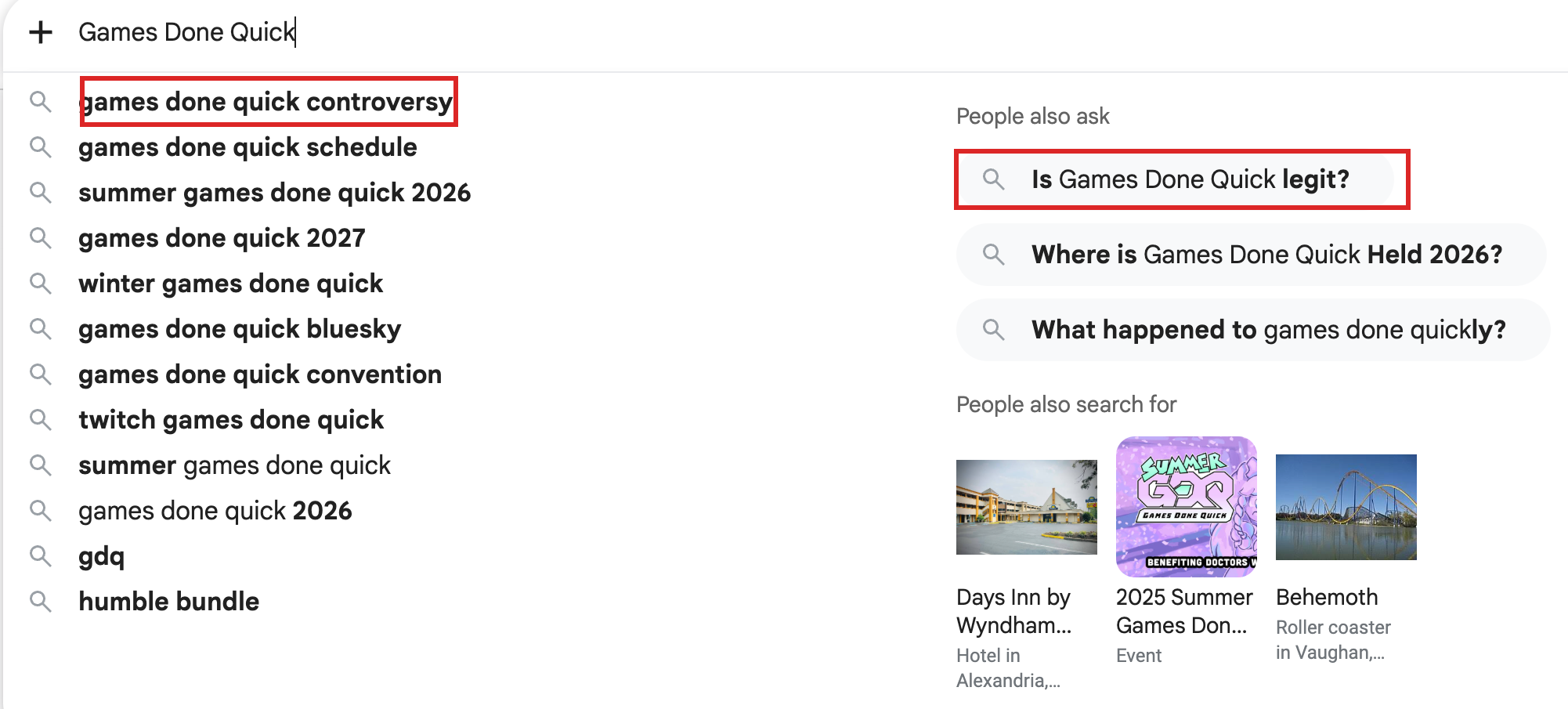
Most crisis coverage fixates on the statement. The Good Good and Callaway ad showed what a defensive, late one costs. Games Done Quick is the useful opposite. When a sponsorship turned into a problem in July 2026, the charity speedrunning organization moved fast, took full responsibility, and refused the money. It was close to textbook. A month later, its own name still autocompletes to "controversy." Why it still does is the lesson, and it is not the one you would guess.
Search the brand and the first thing Google offers is a summary of controversies stretching back years. The clean response to the latest incident did not touch it, because the footprint was never about this latest incident.
What they did right
In July 2026, Games Done Quick announced a sponsored stream with SNK. Its community flagged within minutes that SNK is almost entirely owned by Saudi Arabia's Public Investment Fund and raised the human rights concerns that such ownership entails. GDQ did not stall. Within roughly three hours, it canceled the stream, refused the sponsorship money, cut ties, and posted a statement that took full responsibility without hedging and apologized to the runners and host caught in the middle. Coverage called it stronger than the usual corporate apology. Set against the Good Good response, the contrast is complete: fast, specific, and accountable, against slow, defensive, and self-justifying.
The scar is older than the incident
Here is where the easy version of this story falls apart. If the SNK response was that good, why does "controversy" still trail the brand? Because the footprint was built long before SNK, and by many hands. Google's own summary of the brand does not describe a single event. It describes a pattern going back years: disputes over runner conduct and bans, recurring arguments about the events' direction and tone, and questions about past sponsorships. Pieces from 2016 and 2017 sit in the same results as the 2026 coverage. The autosuggest and the "controversy" association are anchored throughout it, not to any single incident.
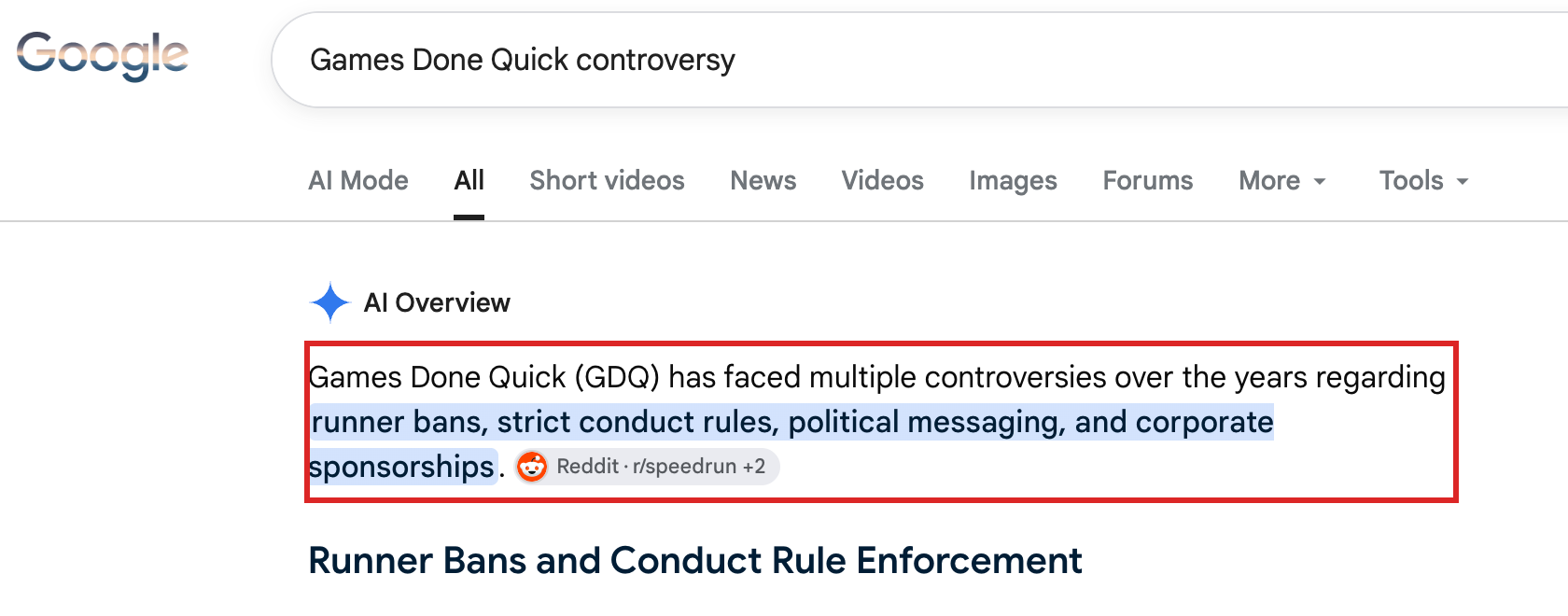
None of that is a verdict on those disputes. Whether any one of them was fair or overblown is not the question here, and this breakdown takes no side on it. The point is mechanical. Each round of coverage, across a decade, added to a durable record that search now compresses into a single word.
Why the footprint outlives any one response
This is the part that should change how you think about recovery. A search footprint reflects the cumulative volume of coverage over time, not the quality of your most recent response. Autocomplete is counting years of people searching the brand next to "controversy," "banned," and the rest, and it keeps offering them long after any single story settles. A flawless response to the current incident shortens that one news cycle. It does nothing to the backlog. You cannot apologize your way out of an archive.
What actually moves it
The response contains the incident. Recovery works the record, and it is a separate, slower discipline. It runs on fresh, accurate, positive coverage that accumulates against the old material over time, on autosuggest and search remediation, and on the surface-by-surface rebuild a strong owned base makes possible. GDQ has real material for it: an organization that has raised tens of millions for charity, including more than $2 million for Doctors Without Borders, at the same event that drew the SNK criticism. The story is there. Someone still has to do the years of work that make search reflect it.
None of this is a knock on how GDQ handled the SNK moment. They handled it better than most. The lesson is that a good response to the latest thing is not the same as a clean search result, and it never clears a footprint a decade of coverage built. The response is one incident. The autosuggest is the whole history. They are different problems on different clocks, and the organization that understands the difference is the one that works both.
The frameworks this breakdown leans on live in the Crisis Communication pillar, Reputation Recovery, the autosuggest explainer, and the Good Good and Callaway breakdown.