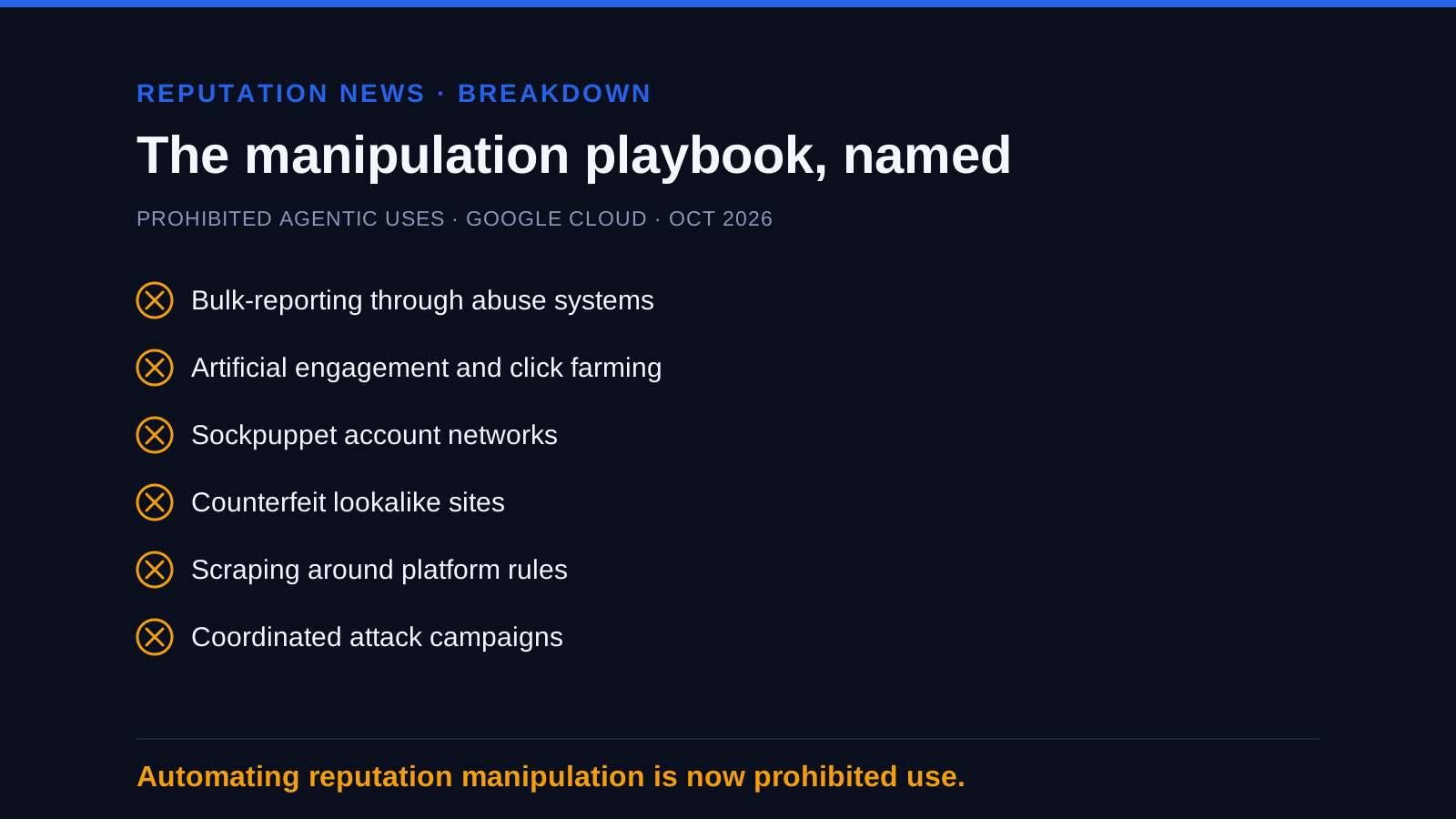
On October 12, Google Cloud updated its guidelines for AI agents. Most of the coverage read it as a security document. Read it as a reputation document and something sharper appears: a near-complete list of the manipulation tactics the reputation gray market is racing to automate, now named as prohibited use.
What the guidelines actually are
These are Google Cloud's Agentic AI Responsible Use Guidelines, the rules for customers building AI agents on Google Cloud and Gemini Enterprise. They supplement Google's acceptable-use and generative-AI policies. This is not a search ranking change, nor is it a new law. It governs what agents may be built to do on Google's own stack. The guidelines are non-exhaustive, and Google says it will update them as technology evolves. That framing matters because the list reads as if it were written with the abuse already in view.
The manipulation playbook, named
Walk the prohibitions against the tactics a reputation operator recognizes.
Bulk-reporting. Agents may not exploit abuse reporting systems for the bulk-reporting of users or content. That is automated mass-flagging, the engine behind a lot of review takedowns and content strikes.
Artificial engagement. Click farming, fake engagement, and interference with polls and traffic analytics. Bought reviews, bought signals, manufactured momentum.
Account networks. Creating or managing numerous accounts to evade detection and circumvent platform safeguards. Sockpuppets and review rings.
Counterfeit identity. Counterfeit websites mimicking authentic domains, phishing, and obfuscating or misrepresenting agent identity. Lookalike sites and fake personas.
Scraping around the rules. Circumventing third-party restrictions on crawling, scraping, or the use of automated technology.
Coordinated attacks. Multi-platform harassment campaigns and automated influence operations. Review brigading and manufactured outrage.
Put together, that is most of the black-hat reputation toolkit, described from the platform's side of the glass.
The one that matters most for reviews
Bulk-reporting is the line to sit with. For years, the quiet mechanism behind a cleared review page was volume: enough flags, from enough accounts, and the platform's automated triage pulls the content. The spam-update slowdown this year already made that harder, and the reason a review comes down has always been which policy it tripped, not how many people complained. The agentic guidelines close the loop. Automating the flag flood is now named as prohibited use on the platform most operators run on. The patient, policy-based removal still works. The bot-driven version now carries platform risk in addition to the ethical one.
What it signals
The gray market spent the last two years moving from manual manipulation to agent-driven manipulation, because agents make cheap tactics cheaper. Fake reviews at scale, flag floods, sockpuppet seeding, lookalike pressure sites. Google just named those uses on its own agentic stack. Enforcement is a separate question from naming, and an acceptable-use policy is not a ranking signal. The direction is still set, and the other large platforms tend to converge on the same lines. Anyone betting their model on automated manipulation is building on ground the platforms are actively narrowing.
The lesson
The durable reputation work was never the flag flood or the review ring. It is the slower, legible version: earn the coverage, fix the entity, instrument the brand so its health shows up as a number. That work does not depend on a loophole, so it does not break when the loophole gets named. The shortcuts are now being named, one platform policy at a time. Build the version that survives the naming.
The frameworks this breakdown leans on live in Review Management, Content Removal, and SEO as Reputation Infrastructure. The review-removal neighbors to this piece are Why Google Removes Your Reviews and A Spam Update Rolls On, and Review Removals Hit a Wall.