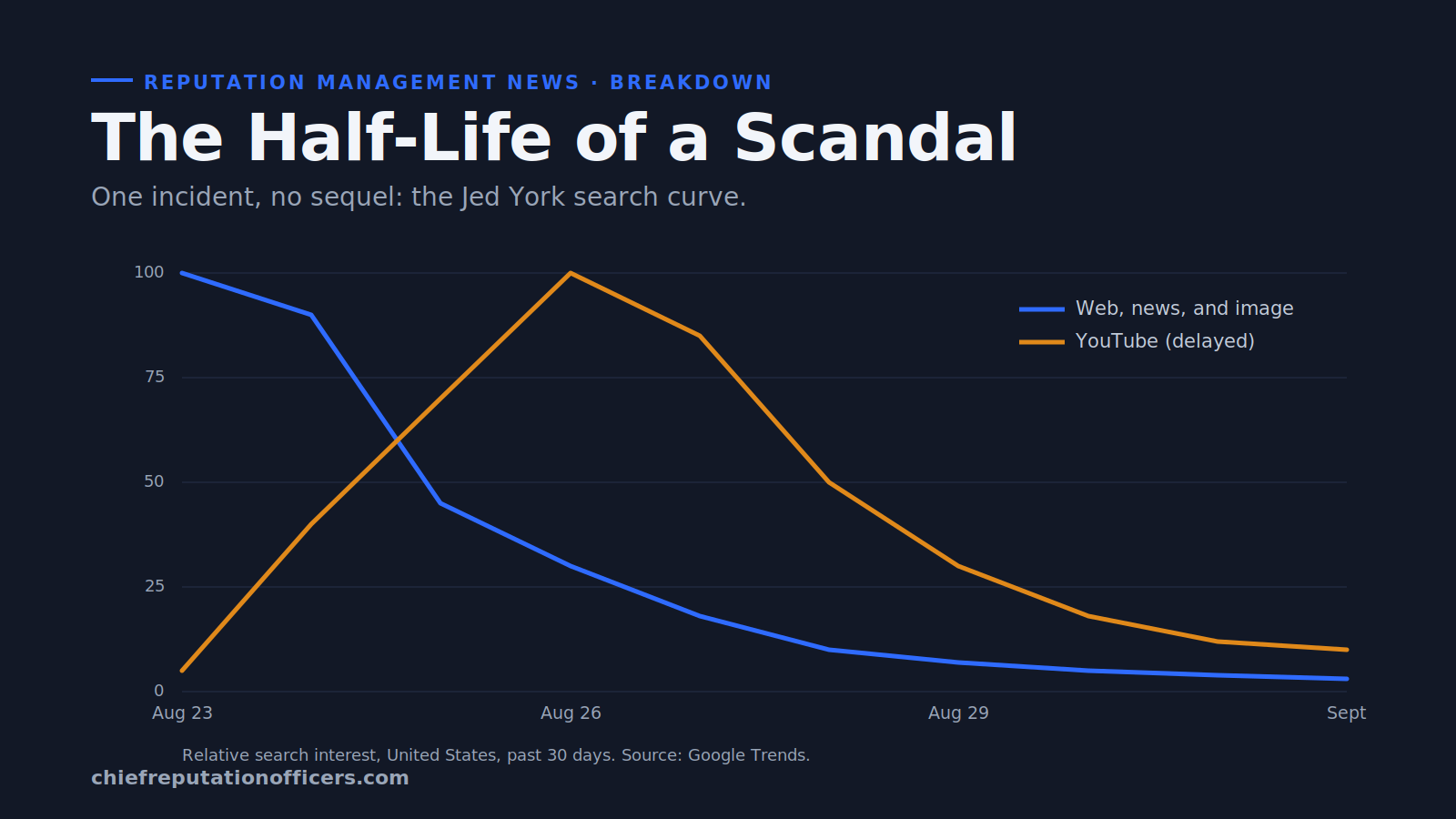
Seven days after the worst headline of his very public career, the search interest around Jed York has almost flatlined. The San Francisco 49ers owner was arrested in Ohio on August 23. The story reached every search surface within hours, and by the end of the week, the curve had fallen most of the way back to the baseline it started from. Reputation work rarely produces a reading this clean. The discipline of not continuing to feed a salacious news story is usually invisible. In this case, it is a chart.
What happened, briefly
York was arrested the morning of August 23 in East Palestine, Ohio, in a sting run with a regional human-trafficking task force, and was initially charged with engaging in prostitution and possessing criminal tools. Under a plea agreement, the prostitution count was amended to disorderly conduct, and he pleaded no contest to the two amended misdemeanors, drawing time served and $1,150 in fines. The coverage was everywhere, from WKBN, which broke it, to ESPN and the San Francisco Chronicle. The 49ers' response, in full, was one sentence: a legal matter, resolved, no further comment. York himself said nothing. That combination, a fast legal resolution and an almost total public silence, is the whole story of the curve that follows.
The curve
In web search, interest spiked on August 23 and was close to a rounding error within a week. Google Trends flagged it as a breakout, more than five thousand percent above the same period a year earlier, and it still fell almost as fast as it climbed. News search and image search traced the same shape: a near-vertical rise, a day or two at the top, then a steep fade with a small aftershock as the follow-up stories and the bodycam release landed. This is what an unfed story looks like in profile. The spike is not the danger. A spike that keeps finding new fuel is.
The surface that lagged: YouTube
One surface broke the pattern. YouTube interest did not peak with the news. It climbed for several days afterward and came down more slowly, with a visibly fatter tail than web or news. The reason is mechanical. Bodycam footage, reaction videos, and podcast segments get produced after the fact, so the video wave crests when creators finish editing, not on the same curve as the news break. For anyone managing a live incident, that lag is worth internalizing. The text surfaces spike and fade with the news cycle; video runs a few days behind and lingers, because it is made rather than reported.
Where the interest lived
Geographically, the heat concentrated exactly where you would predict. Ohio led every state, since the incident happened there and York was raised in Youngstown, followed by California, the team home. The District of Columbia, Nevada, and Pennsylvania rounded out the top five. A story like this pools where local-news gravity and fan interest overlap and stays comparatively quiet everywhere else.
What people actually searched
The query mix is a study in how a scandal introduces a low-profile executive to people who never knew his name. The rising searches were led by the basics, who he is and which team he owns, alongside the two curiosities that always trail a wealthy figure in trouble: his net worth and his family, both ranking near the very top. Under those sat the factual cluster: the arrest, the charges, the location. The reporting itself generated some of the volume: early accounts disagreed on the amount involved, the sum arranged, and the sum police later seized were different figures, and the muddle sent people back to Google to settle which number was right. Then came the mockery, sharpened this time by the calendar. The arrest landed the same week fantasy drafts ramp up for the new NFL season, so the jokes found a ready format and fantasy-team-names riffs spiked right alongside the facts. Searchers even reached for precedent, pulling up Robert Kraft, the last NFL owner to face the same kind of sting. None of it is surprising, and that is the point: almost all of it is transient. Curiosity queries spike with the news and fade with it.
The layer that lingers: autosuggest
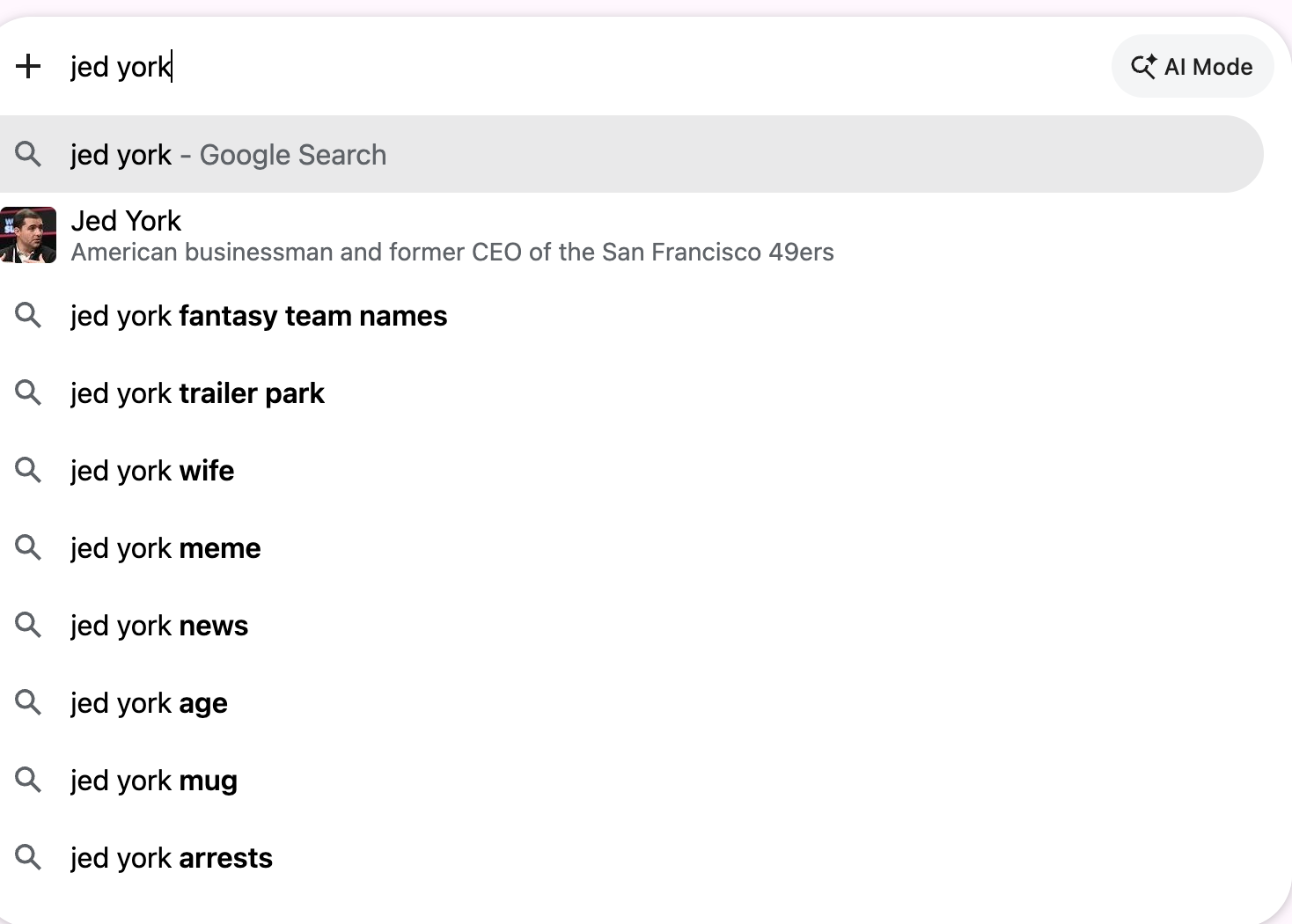
The spike is only the visible layer. The results page itself will slowly resolve as ordinary news about the team, and eventually his philanthropy, layers back over the top; these pages tend to heal. Underneath the results page, though, sits autocomplete, built from aggregated search volume over a longer window, which means it lags the news and then outlives it. Type the name now, and the suggestions blend three things in one dropdown: the ordinary queries any public figure carries, net worth, family, news; the scandal, the arrest, the booking photo, the Ohio location; and the mockery, a fantasy-team-names riff sitting one line away from a serious question. The news cycle is a spike. Autosuggest is sediment. It is built to reflect months of behavior, which makes it slow to form, and yet it is the surface most exposed to the volume of a single loud week, and it is what the next person to type the name will meet long after the headlines have gone quiet.
Why it faded
The 49ers gave the cycle one sentence and no sequel, and that is why it burned out. There was no press conference to clip, no defensive post to quote back, no second statement to contradict the first, no interview that produced a new headline. A resolved legal matter with no fresh fuel has a short half-life by default. The contrast with the recent Good Good episode is exact. There, a chief executive answered the criticism, then answered the answers, and turned a one-day embarrassment into a week-long story using nothing but his own words. Silence starved one story; noise fed the other, and the search curves are the receipts.
The NFL exception
York's silence is only half the answer, because he had help that most people in trouble never get. An ordinary company does not survive a scandal like this. The NFL is not an ordinary company; it is closer to an American institution. In his 2026 book Football, the critic Chuck Klosterman calls the sport a hyperobject, a thing so culturally vast that its real dimensions hide in plain sight, and notes that in 2023, 93 of the 100 most-watched programs on American television were NFL games. A machine that size makes its own weather. A seventeen-week season, thirty-two teams, and a fixed amount of daily airtime mean the running soap opera of games, injuries, trades, and playoff races is always overwriting what came before. An owner's scandal is not resolved so much as buried under next week's slate, out of sight and out of mind, and at this point almost expected.
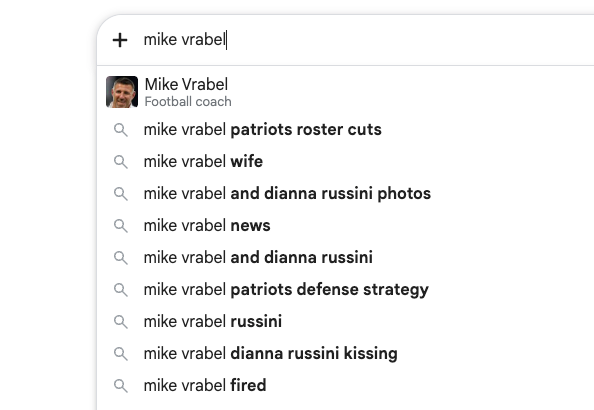
The machine treats an owner and a coach differently, though, and the gap is instructive. Robert Kraft's 2019 prostitution-sting case is the closest precedent; seven years on, his search results have largely healed, folded back into the ordinary mix of team news and philanthropy. A head coach gets no such grace, because a coach is judged every Sunday. Mike Vrabel is the live example: photos with an NFL reporter, both denying anything improper, and yet an autosuggest still crowded with the rumor months later, in a way a denied and dormant story should not be. Whether it fades, as Mike Tomlin said out loud, comes down to winning: a fast start quiets the noise and a bad one makes it much louder. That is the system in miniature. The coach, the working end of the sport, answers on the field in real time. The owner mostly waits out the cycle. Same league, two standards of consequence.
The caveats
None of this makes silence a universal prescription, and treating it as one would be a misread. Saying nothing worked here because the matter resolved quickly, there was no open dispute or unanswered question to keep reporters working, and there was nothing York could add that would not simply restart the clock. Where a story has live threads, identifiable victims, or the look of a cover-up, silence reads as evasion and tends to make things worse. Three threads stay open, though none is likely to top what has already happened. The salacious spike was the peak; when the NFL publishes its discipline under the personal-conduct policy, expect a second and smaller wave, a new headline on a story people already know rather than a fresh discovery. The season opener is days away, which puts the team, and by extension its owner, back in front of an audience already primed for the joke. And the mockery tail always outlasts the news tail, because jokes fade slower than facts. Silence buys decay. It does not buy erasure.
A week after the worst day, York's line is nearly flat, and not because the story was minor. It is flat because no one kept it breathing, and because the largest media machine in the country had a hundred other things to show by Sunday. Most companies get no such help, which is what makes the one controllable move matter more for them, not less. The hardest thing to do in a resolved crisis is also the most effective, and it is the one most people cannot manage: say the single necessary sentence, and then, in public, do nothing at all.
The contrast case is the Callaway and Good Good aftermath breakdown. The frameworks this piece leans on live in the Crisis Communication pillar and The CRO Role.