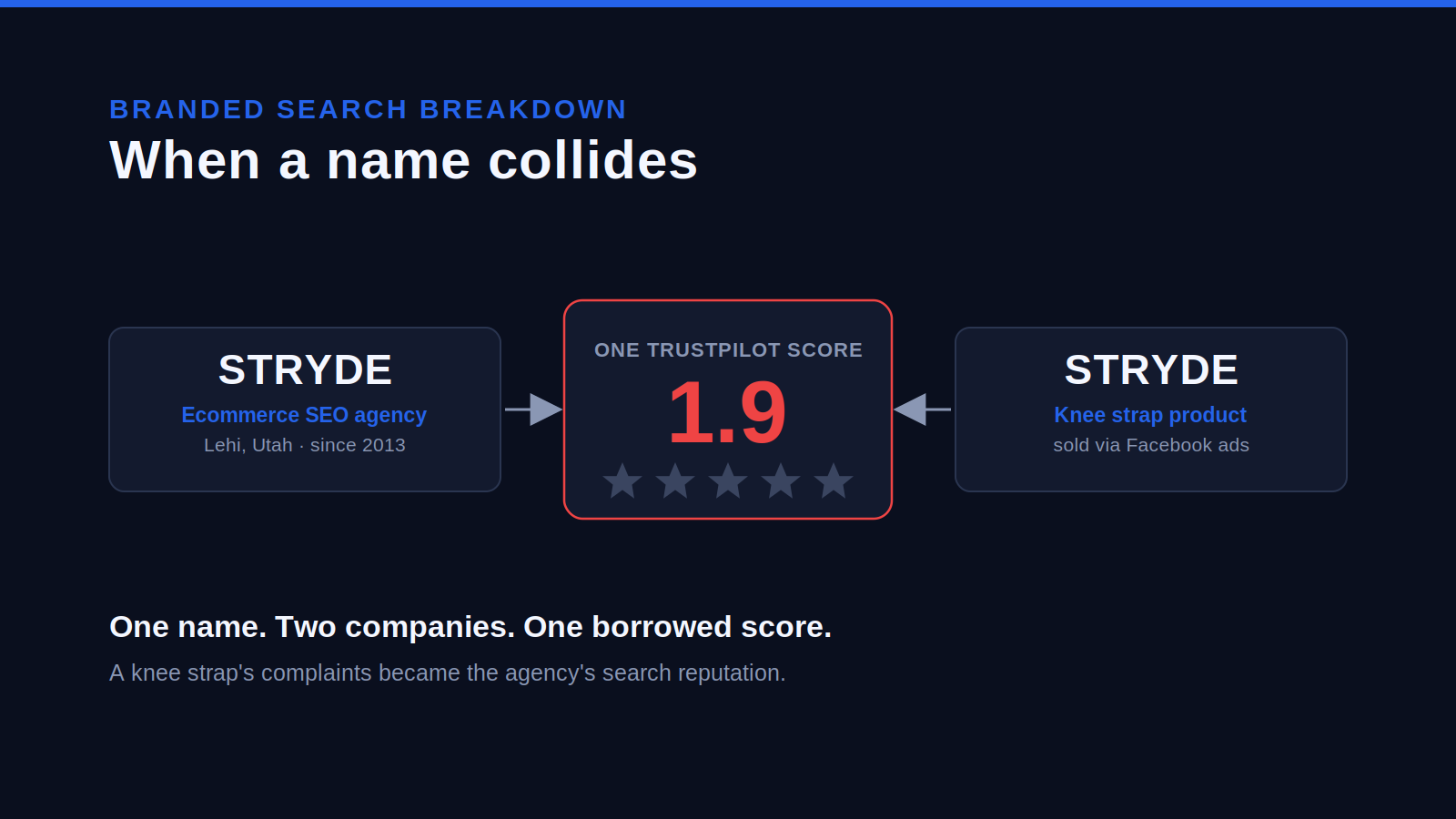
A Utah marketing agency now carries a 1.9-star rating on Trustpilot, built almost entirely from people who never hired it and never meant to review it. They were buying a knee strap. Stryde, the agency at stryde.com, has spent thirteen years selling ecommerce brands on search engine optimization. It is now the object lesson in the one search surface it forgot to defend: its own name.
Two companies, one name
There are two Strydes in this story. The first is Stryde, a boutique ecommerce marketing agency in Lehi, Utah, founded in 2013, that runs SEO and paid media for online brands and pool and hot tub dealers. The second is a Stryde knee strap, a patella band sold to consumers through Facebook ads for around thirty dollars and shipped from overseas. The two have nothing to do with each other except the word on the label.
Consumers who bought the strap and went looking for a place to complain did what consumers do. They searched the brand name and typed the obvious domain. Trustpilot's page for stryde.com, the agency, is where they found and left their reviews. Nearly sixty of them now sit on the agency's profile; seventy-nine percent are one star, and almost none of them are about the agency.
What the reviews are actually about
The reviews describe a product the agency does not make. They report straps that took weeks to arrive from abroad, that felt flimsy for the price, that did nothing for arthritic knees, and refund requests that went in circles. Several use the word scam. Trustpilot's automated review summary, the one that sits at the top of the page and feeds AI answers, now reads the agency this way. It describes poor quality straps, long delivery times, and unexpected overseas shipping, as though a Lehi SEO shop had sold them.
That is the mechanism worth watching. The score is wrong on the merits, and it does not matter. Trustpilot's algorithm counts the reviews. Google reads the aggregate. AI summaries repeat it. The rating attaches to the entity named Stryde, and search does not pause to ask which Stryde earned it.
Claiming the profile was the right move, and thirteen years late
To the agency's credit, someone finally noticed. Stryde claimed the Trustpilot profile in July 2026 and wrote its own description, correctly identifying itself as a digital marketing agency. That is the right first step. It is also the tell. A firm that sells branded search for a living waited until a wave of misdirected one-star reviews had already landed before it claimed the single most visible third-party page carrying its name.
There is a smaller miss inside the big one. That company description, the one field on the profile the agency fully controls, does not warn anyone that this is not the knee strap. It reads as a straightforward marketing agency bio. The one place a visitor could be told, at a glance, that they have the wrong Stryde is left generic, and the correction is buried one level down in the individual review replies where only the writer of each review will see it.
Zero removals out of eight flags
Here is where a bad break turns into a competence problem. The agency did flag reviews. Trustpilot's own flagging record shows Stryde challenged eight of them. All eight are still online. None were removed. Trustpilot reviewed each one and ruled that none breached the guidelines for the reasons Stryde selected. Eight flags, zero removals, a clean shutout in the wrong direction.
That outcome is not Trustpilot being stubborn. It is a flag filed on the wrong grounds. Trustpilot has its own issues, and unfortunately businesses are stuck playing by their rules. Trustpilot removes reviews that are not based on a genuine experience with the business, and the reliable way to trigger that is to challenge the interaction itself and let the platform ask the reviewer to prove a purchase. These reviewers bought a knee strap from a different seller. They cannot provide proof of purchase from a Lehi marketing agency because there was none. Flagged on that ground, the reviews come off. Flagged on almost any other ground, as these apparently were, they stay up, and the meter keeps running. A separate batch of twenty-four flags now sits under investigation, so the agency may be learning the distinction in real time. It is learning it eight losses in.
The tools were there the whole time. Trustpilot publishes its removal criteria, runs a content integrity team, and offers business support to walk a company through exactly this kind of misattribution. Using them is not obscure knowledge. It is the daily work of the reputation trade, and it is adjacent to what this agency sells.
Good at SEO is not good at reputation
None of this is a story about a clueless firm. Stryde is visibly competent at search. The domain rates around fifty on the usual authority scale and draws links from roughly fifteen hundred sites; its homepage carries a full structured data graph, its pages rank, and it went to the trouble of publishing a dedicated page warning the public about impersonators, the fake job offers and investment schemes that borrow its name and logo. That is a company that thinks about brand abuse. It built a real defense for one kind of reputation threat.
It built only that one, and even that one aims at the wrong target. Across the keywords the agency's site ranks for, only seven contain the word Stryde. Several of those belong to other companies. The site ranks for stryde management pyramid scheme, stryde management reviews, and stryde medical underpayments, the troubles of unrelated Strydes, all caught by the scams page it built for itself. It owns the bare name and sits first for stryde marketing. Add the word "reviews," though, and it drops out of view. On “stryde marketing reviews”, the query a buyer actually types, the agency's own voice barely registers. What surfaces instead is a notice about impersonators, which has not been updated to mention the knee strap. Around it sit the 1.9 Trustpilot profile, a Reddit thread about a different Stryde accused of a job scam, and a Glassdoor page titled "fake job offers". The schema underneath tells the same story in miniature. The Organization markup lists a name, a URL, and a logo. It leaves out sameAs, the one property whose whole job is to connect an entity to its real profiles and tell Google which Stryde this is. That single signal, the one that would set the agency apart from the rest, is the field they left blank.
The footprint is thinning, too. That set of keywords spans the last six months, and roughly forty-five have already dropped off in that window, with the live tally even lower because the dashboard counts only terms that still hold a top-100 spot. Some of the slide traces to the recent churn in search and AI results, which has trimmed plenty of sites, so it is not proof of neglect on its own. The branded problem is the one no algorithm decides. A company either defends its own name or it does not, and this one did not.
The same gap shows on the agency's own site. It publishes case studies dressed in the logos of well-known clients, which show who hired it, and has no testimonials or reviews section, which would show what those clients actually say. Logos borrow authority. Testimonials build it. For a firm that markets itself on surfacing in AI search, skipping that second layer is a strange omission, because first-party reviews and testimonials are exactly the structured, quotable material those systems reach for. Off the site the accurate reviews stay scattered and modest, a handful on Clutch and four on a topseos profile whose title does not even call Stryde a marketing agency, while the one profile with real volume is the wrong one, the Trustpilot page full of knee straps.
Strong search mechanics and strong reputation control are related disciplines, not the same one. A firm can rank all day and still lose the plot on what its own name returns. Stryde is the proof, which is the uncomfortable part, because reputation is what its clients are buying when they buy SEO.
The score becomes the entity
This is why branded search is not a vanity metric. A rating is not a number that lives on Trustpilot. It is a fact that Google indexes, that a rich result can display under the brand name, and that an AI assistant will recite when someone asks whether Stryde is any good. Google's own AI Overview already tries to referee the mess. It calls Stryde a legitimate agency in one breath and, in the next, notes that the name is frequently confused with unrelated entities, including a door-to-door sales operation called Stryde Management and a series of product scams using the same name. That is Google performing the disambiguation the agency never performed for itself, and the People also ask box directly below opens with the question the whole situation plants, whether Stryde is a genuine company. None of this stays on one page. The agency already surfaces in dozens of AI Overviews and across ChatGPT, Gemini, Perplexity, and Copilot, so whatever its name means now, the answer engines are repeating it at volume. Prospective clients, ecommerce brands vetting a marketing partner, run exactly that kind of search before they sign, and what sits at the top is a 1.9, a Trustpilot summary about defective knee straps, and a flagging history that reads zero for eight.
That last part is the quiet cost. A prospect does not just see a bad score; it can eventually be explained away as mistaken identity. It sees a search and reputation firm that could not get eight plainly misattributed reviews removed from its own profile. The knee strap company, for what it is worth, has a 4.4 rating on its own Trustpilot page. The misdirected reviews did not just harm the wrong party. They inverted the picture, dragging the agency below the product it keeps getting blamed for, and then the agency's own handling gave prospects a second reason to pause.
What protecting your home turf looks like
The lesson is not that name collisions are rare or unforeseeable. They are neither. Plenty of brands end up sharing a name. Plenty more get branded a scam on purpose by a bad actor. Entity management and monitoring is the discipline that catches both: knowing what every profile and answer engine says about your name, week to week, and moving the moment it drifts. Defending a branded search result is a standing task, not a fire drill, and the firm best positioned to know that got caught flat and then fumbled the cleanup.
Protecting the home turf here looks like a short list the agency could have run at any point in the last thirteen years. Monitor the branded search result and every third-party profile that ranks on it. Claim those profiles before there is a reason to, and use the profile bio itself to disambiguate the name in plain sight. When misattributed reviews land, flag them on the one ground that removes them, no genuine experience with this business, and let the proof of purchase request do the work. Escalate to the platform's support team rather than negotiating in the public reply box. Fill in the entity signals that are missing, starting with the sameAs the Organization schema leaves blank, so Google and Trustpilot can tell the Strydes apart. None of this is exotic. All of it is what the agency would bill a client to do.
Stryde will likely climb back, especially if those twenty-four pending flags are filed on the right grounds. The score will recover. The collision behind it will not, because the other Stryde is an e-commerce brand, the agency's own market, and as that product spends more on ads and pulls more searches, the two names collide harder rather than drift apart, and the misattributed reviews keep arriving. What makes the episode instructive is that it came to this at all, and that the recovery is taking eight failed attempts to find a removal path a reputation firm should have known cold. No brand should lose control of its own name, least of all an SEO agency. For months, on the most visible page carrying its name, this one did, and the record of the struggle is now public too.
The frameworks this breakdown leans on live in Review Management, Brand Reputation Management, Crisis Communication, and Google Entities. The entity-hardening neighbor to this piece is The Converse Ad Drama and the Search Scar in the Balance.