In the third week of September, a Converse advertisement became a national story for the worst possible reason. An image from the brand's Chuck 70 X campaign, showing the K-pop singer Karina in a long white skirt holding a pair of the sneakers, drew widespread comparisons to Ku Klux Klan imagery and to the visual language of a lynching. Within days, it was on every major news outlet, and Converse, which is owned by Nike, apologized and pulled it. What happened next is the part worth studying, and it is not finished. By moving quickly, the brand gave itself the best available odds against the thing that actually lasts, a damaged branded search result. Whether it wins that race is being decided right now in the search data of the days that follow.
What happened, and how fast
The facts are not in dispute. The campaign image circulated in September, the backlash built over a weekend, and by September 20 and 21 it was being covered by CNN, CBS News, Adweek, and the footwear trade press. Converse issued a short statement to reporters: "We're sorry. We understand why this image is deeply upsetting and recognize that we got this wrong. We removed it from our channels and are working to remove it everywhere it appeared. This should not have happened, and we will do better." The company did not litigate intent or explain how the image was made. It named the harm, said it got the decision wrong, and took the asset down.
Compare that clock to a crisis that drags. The response came within the same news cycle as the outrage, not a week later. Speed is doing quiet work here that most coverage will miss, because the audience for a fast takedown is not the angry crowd on social media, who will stay angry regardless. It is the search engine, and the permanent record it was deciding whether to write.
The part that does not fade
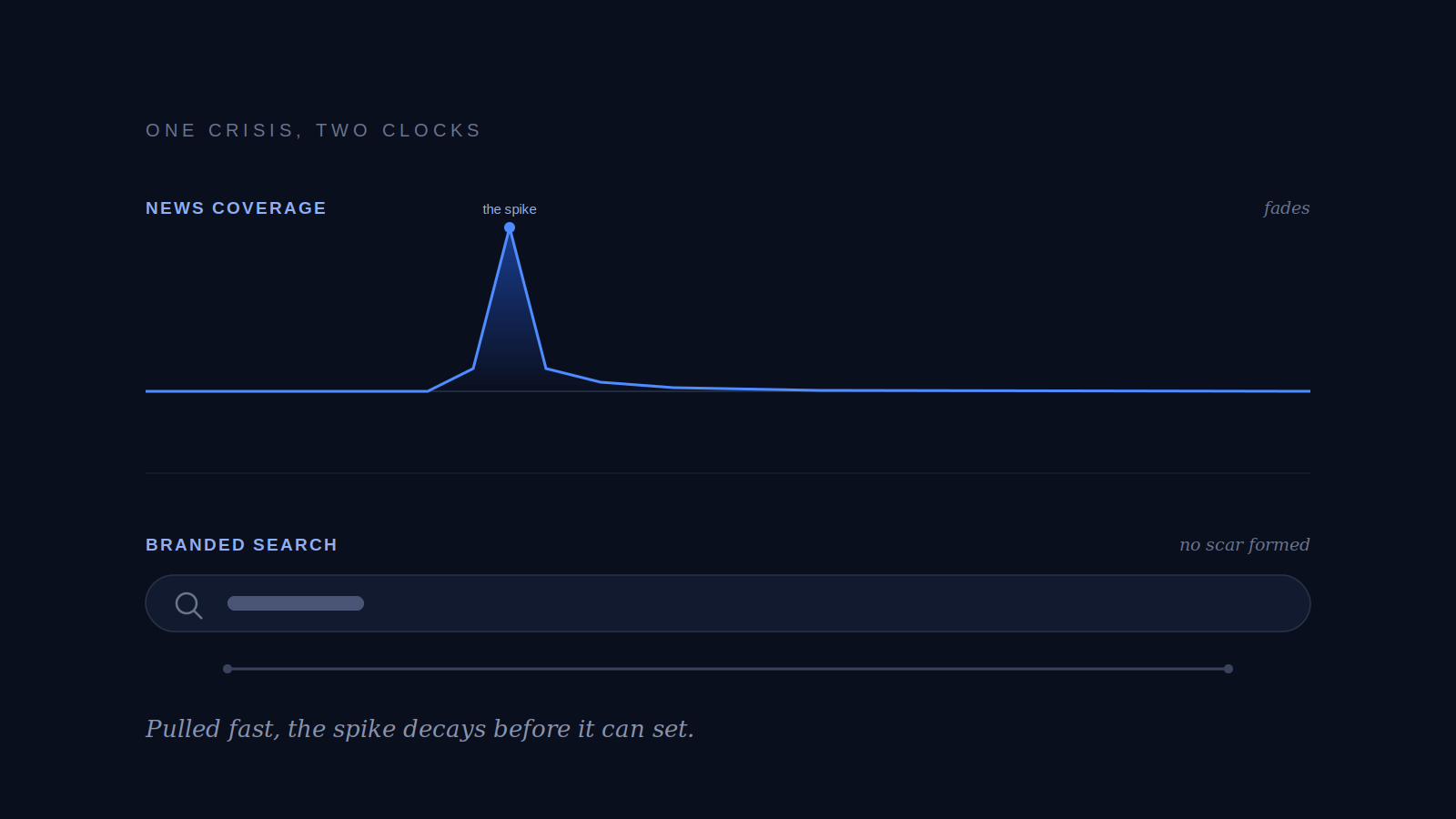
A news cycle is often loud and very short. Search engine traffic is quiet and long. The two operate on completely different clocks, and reputation management lives on the second one. Right now, a search for the brand plus the word "ad" returns news coverage and an AI summary describing the controversy, because that is what the last few days have produced. That layer decays. News articles slide down the results as the story stops being new, and the AI summaries follow the sources.
The layer that does not decay is the one still in play. When a controversy sustains enough volume for long enough, it stops being a passing story and becomes part of the entity itself. Search autocomplete starts offering the ugly permutations of the brand name before a user finishes typing. The first page of a plain brand search settles into a version that leads with the scandal. Those signals are built from sustained behavior over time, and once they set, they are extraordinarily hard to reverse. The honest question is not whether that has already happened to Converse. It is which way the current data points, and the data points in two directions at once.
Two searches, two verdicts
Google Trends tells the story in two views, and they do not agree. Filter the brand-plus-ad query to News Search, and the curve is a run of sharp spikes that fall back toward zero within days, and the related-query panel comes back empty. News-tab searching is event-driven. It burns and leaves nothing behind. That is the news layer doing exactly what the news layer does, and on its own it looks like a brand getting off clean.
Switch the same query to Web Search and a different picture appears. The related queries fill with the associations no brand wants attached to its name, the comparisons to Klan and lynching imagery, the word controversial, the model's name bound to the scandal, several of them flagged as breakout. Web search is not the news tab. It is the pool that feeds autocomplete and the people-also-search-for carousel, which is the durable layer. Watching the negatives surge there is the signal that counts, and it is the one a clean news-decay curve hides from anyone who only checks the news view.
So the takeaway is not that no scar formed. It is that the news layer is already cooling while the durable layer is being tested in real time. The permutations surfacing in web search are co-search spikes tied to the event, not yet the calcified predictions autocomplete serves unprompted. Whether they harden into that depends on one variable: whether the volume sustains past this week or falls off with the story. That is the number to watch, and it is not settled.
Why speed is still the right bet
This is the mechanism underneath the tempo. A visual controversy runs on the oxygen of the asset staying live. Every hour the image is still up is another hour of screenshots, reaction videos, and fresh searches, and it is that sustained search volume, not the peak, that teaches autocomplete and the ranking systems to treat the scandal as a defining fact about the brand. Pull the asset early and apologize plainly, and the spike is sharp but short. It reads to the systems as an event, not an identity. Leave it up and argue about it, and the same volume stretches across weeks, which is the shape that calcifies into a permanent search footprint. Converse did the one thing that most starves the durable layer, and it did it fast. That does not guarantee the outcome. It changes the odds, which is the most any brand controls once the asset is already public.
What speed did not fix
None of this makes the episode costless, and an honest breakdown has to say so. The ad still shipped. As the civil rights attorney Lee Merritt noted, an apology "doesn't undo what got past legal, marketing and leadership at every step," and the more expensive failure was the one before publication, the review that should have killed the image and did not. The statement had its own flaws. It described a single image, while trade reporting pointed to more than one, and it claimed the content was removed, even though outlets could still find it live when they published. Nike, the parent company, said nothing, and its shares edged lower amid the coverage. Speed did not repair the trust the ad damaged or answer how the thing cleared every internal gate. What speed did was hold down the volume in the layer that lasts, which is a narrower win than a clean record and a real one all the same.
The contrast that makes the point
The value of moving fast is easiest to see when contrasted with a case where a brand did the opposite. When a company meets a self-inflicted visual crisis with a slow, defensive, or contradictory response, the story does not resolve; it extends, and the extended version is what search preserves. The negative gets the weeks of sustained volume it needs to move from the news layer into the durable one, and the brand inherits autocomplete and a first-page it will spend years and real money trying to clean. Same category of mistake, opposite handling, opposite search outcome. The difference is almost entirely tempo.
The lesson
For any brand that ships a self-inflicted visual mistake, the instinct is to slow down, get legal comfortable, and craft the perfect statement. That instinct protects the wrong thing. The durable reputation cost of a visual scandal is decided less by the wording of the apology than by how fast the asset comes down and how plainly the brand owns the error, because those two moves determine whether the negative decays as a news cycle or sets as a permanent search result. Converse did not avoid the scar. It bought itself the best conditions to avoid it, and now the web-search volume it starved has to stay starved. The apology will be forgotten. The speed is the reason the question is still open, instead of already answered against the brand.
The frameworks this breakdown leans on live in the Autosuggest pillar and How Google Autocomplete Actually Works, and in Crisis Communication. Related breakdowns: When Good Good Goes Bad and Reputation Is Not Visibility, and, for the name-collision case where a rating attaches to the wrong entity, When Knee Pain Turns Into Reputation Damage.