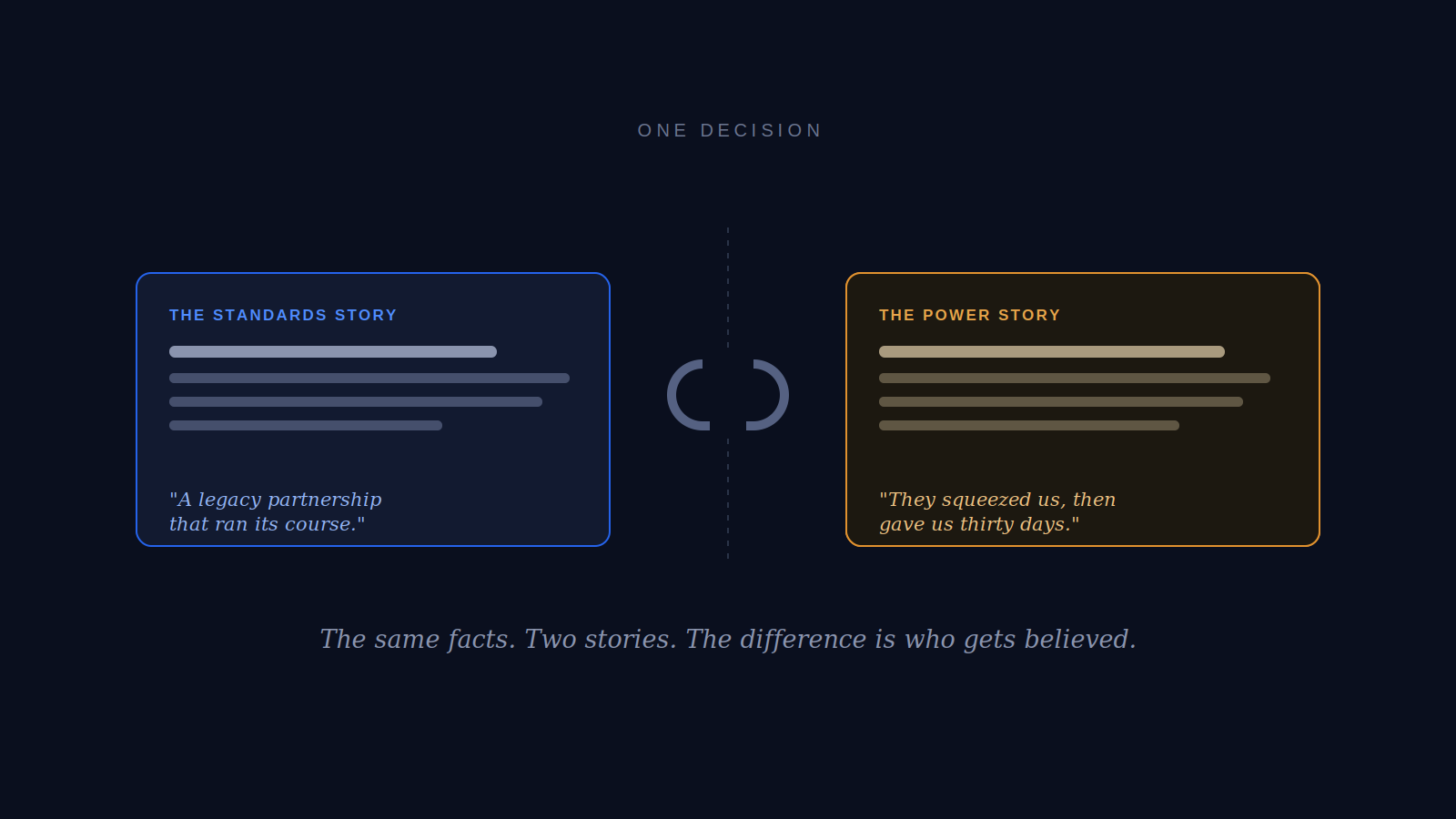
In August, a nine-year software partnership ended, and within days there were two completely different explanations for why. ServiceTitan, the system of record that most large home-service contractors use to run their businesses, switched off its integration with Podium, a reputation-management tool for local businesses. Roughly a thousand contractors who used both were given about thirty days to adjust, in the middle of peak season. Then each company told the story in its own way, and the gap between the two versions is a useful lesson in how business reputation is actually decided.
Two stories
ServiceTitan's account is about standards. The company had launched a certification program for its app marketplace, with technical requirements and fees, and its position is that Podium's arrangement was a legacy deal that had, in its co-founder's words, "run its course." Podium was offered certification on the same terms as everyone else but declined, so the integration could not continue. The framing is orderly and principled: a growing platform holding all partners to one standard.
Podium's account is about power. Its chief executive told customers that ServiceTitan had spent two years changing the terms, wanted a large cut of Podium's revenue, and wanted Podium to stop building anything that competed with it. He said the company went unresponsive for months, then delivered a termination notice with 30 days to sort it out, and that Podium learned of it officially at the same moment its customers did. The framing is a story about a bigger company squeezing a smaller one and passing the cost on to shared customers.
Both of these are true enough to defend and partial enough to serve their tellers. That is what a framing looks like. Neither company is lying, and neither is giving you the whole picture, because each is describing the same events from the position that flatters it most.
What was actually underneath
The substance both sides are shaping is not complicated. Podium started as the layer in front of the record: the text message from the truck, the webchat, the review request after a job closed, the reputation work. Over the last two years it expanded into a full platform that now markets its own scheduling and dispatch, with a team that migrates a contractor off the old system in two weeks. A partner that once fed data into ServiceTitan and made it stickier had become a product that replaced it. ServiceTitan, for its part, had published the rule that fits this exact situation about seven weeks earlier, welcoming partners that overlap with it but not those using the partnership to displace it. The reputation-and-marketing layer had grown into a competitor, and the platform beneath it moved to cut it off.
None of that makes either company a villain. Following your customers into a larger product is ordinary ambition. Enforcing your own marketplace rules is a platform's right. The interesting part is not who was within their rights. It is why the two explanations landed so differently with different audiences.
Reputation is not the press release
The first lesson is that when you make a self-interested decision, you do not get to choose whether there is a competing story. You only get to choose how well positioned you are when it arrives. ServiceTitan could publish the cleanest standards rationale in the world and it would not stop Podium from telling a squeeze story, because both descriptions fit the facts. The question was never which company would control the narrative. Neither controls it. The question is which version each audience already believes before it reads a word.
Relationship capital decides who is believed
That is where the most telling part of this played out. One of ServiceTitan's founders did not hide behind a corporate statement. He posted under his own name, explained the decision in plain terms, and offered to personally take calls from any affected customer. What followed in the replies is the whole point: contractor after contractor and partner after partner vouched for him, not because of the certification argument, but because of years of dealing with him and finding that he did what he said he would. The standards frame was persuasive to people who already trusted the man who made it, and the squeeze frame was persuasive to those who did not. The reputation each company had built long before this dispute is what decided whose version of it stuck. Goodwill accumulated in ordinary times is exactly the reserve you draw down in a contested moment, and you cannot open the account the week you need it.
The bill is set by the bystanders
The second lesson is about who paid. Both companies were within their rights, and being within your rights turns out to be nearly irrelevant to how a decision reads. The reputational damage did not come from the certification policy or the competitive strategy. It came from the roughly 1,000 contractors who signed nothing, saw none of the negotiations, and were given 30 days to rebuild a piece of their operations during their busiest weeks. As one industry analyst noted, ninety days instead of thirty would have cost the platform almost nothing, and it would have changed the entire story. How you treat the people caught in the middle of a fight they had no part in is the part of a reputation no framing can rescue. A legal decision and a defensible decision are not the same thing, and the difference is usually measured in how much of the cost you were willing to absorb yourself.
What it means for everyone else
For anyone who runs their reputation through software, and most businesses now do, there is a practical warning underneath the drama. The review requests, the messaging history, the automated follow-ups, the customer record: much of that lived in an integration between two companies that a contractor did not control and could not monitor while they negotiated. When it broke, it broke on someone else's schedule. Your reputation stack is a lease, not an asset. It is worth knowing, before you need to know it, which parts of your customer relationship you actually own and which parts vanish the day two vendors stop getting along.
And for anyone who will one day make the hard, defensible, self-interested call, this split is a compact case study. You will have a rationale. The other side will have one too. Which one survives depends on the reputation you built before the decision and on how visibly you protected those with no say in it. Reputation is not the statement you release when the fight starts. It is what your record has already earned you the right to be believed about.
The frameworks this breakdown leans on live in Brand Reputation Management, Review Management, and Crisis Communication. For the customer-side version of a reputation stack that fails, see the Reputation Is Not Visibility breakdown.