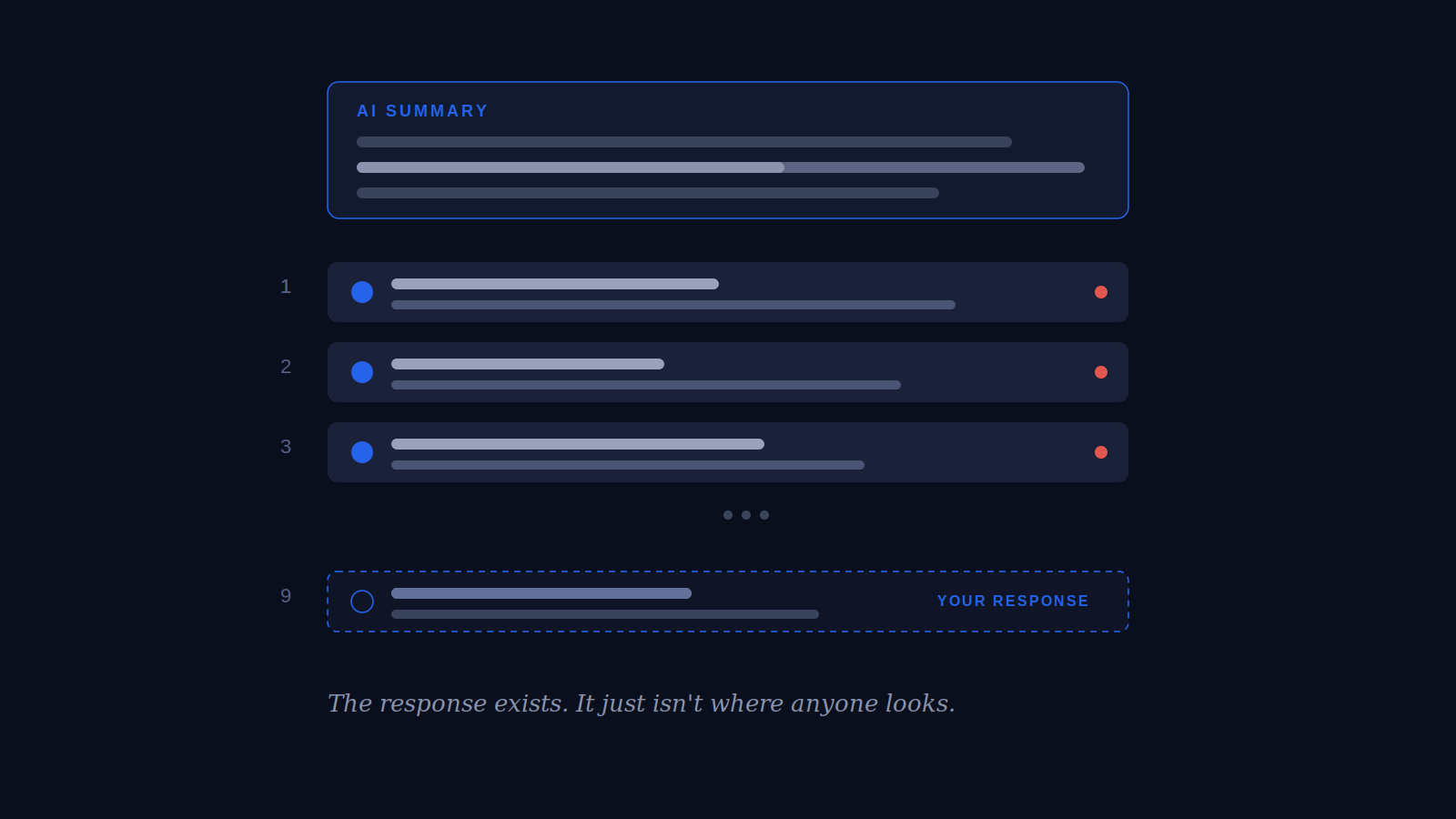
A direct-sales firm in a large Midwestern city recently did something most companies in its position never attempt. Accused on a watchdog subreddit of being a "devilcorp," it wrote a calm, point-by-point response, published it, and invited anyone to check the facts for themselves. By the standards of corporate self-defense, it was a good piece of work. Months later, the accusation still sits at the top of the company's search results, the rebuttal is nowhere near it, and the forum has a fresh thread dissecting the attempt. The story is worth studying precisely because the company did not blunder. It made a reasonable move that still failed, and the reasons it failed are a short course in how reputation actually works online.
What a "devilcorp" accusation is
"Devilcorp" is an internet label, born on Reddit, for direct-sales and customer-acquisition offices operating within larger broker networks. Critics apply it to firms they believe rely on commission-only pay, recruitment-driven advancement, and vague job titles that obscure the nature of the work. It is a contested and loosely applied term, and the company at the center of this case argued, with some justification, that it gets thrown at nearly any face-to-face sales operation regardless of the details. Whether the label fits is not the question this breakdown is trying to answer. How a business should respond when the r/devilcorp label attaches to its brand name is.
What the company got right
Set the outcome aside for a moment, because the response itself was sound. The company did not rage, sue, or pretend the thread did not exist. It published a measured account: what the business is, who runs it, how long it has operated, and a direct answer to the specific criticisms, with an invitation to verify each claim independently. That is close to textbook. Most companies facing a reputation attack either go silent and let the accusation stand or lash out and hand the critics more material. This one addressed the substance in a calm, checkable way, which is exactly what a good advisor would recommend.
Why it failed anyway
The rebuttal failed for a reason that has nothing to do with its content and everything to do with its placement. It was published on a free, low-authority blog, separate from the company's main website, and on a page that has almost no chance of outranking Reddit, Glassdoor, Indeed and an established watchdog publication on a branded search. A response that does not rank is a response no one reads. It may be honest, thorough, and completely correct, yet still read like a private diary entry, because the searcher who needs to see it never scrolls far enough to find it. Writing the defense was the easy part. Positioning it to be seen was the part that got skipped.
The battle it chose was also the wrong one. No amount of content will let a small company outrank Reddit for its own name plus "reddit," or plus the pejorative of the moment, because those queries belong to the discussion by design and Reddit is one of the highest-authority domains on the web. The winnable ground is elsewhere: the core brand search and the reviews query, where a strong owned site and real customer feedback can hold position. Effort spent trying to bury the unwinnable term is effort not spent defending the ground that can actually be held.
Who the response was for
There is a deeper misread underneath the tactical one. A rebuttal aimed at a hostile watchdog forum targets the one audience that will never accept it. Sure enough, the community answered the company's post with a new thread picking it apart, which is the predictable result of engaging a room built to be skeptical of exactly this kind of statement. The response was never going to convert the forum. What it could have done, positioned correctly, is reassure the neutral searcher: the job candidate or prospective customer who runs the search once, sees the accusation, and wants to know whether there is another side. That person is who the work is for. The forum is a fight you decline; the searcher is the reader you serve.
The part that moved up a layer
A newer wrinkle makes all of this harder. The search page no longer ends at the links. An AI summary now sits atop the results, and in this case it has already absorbed the accusation, presenting the "devilcorp" framing as a settled description drawn from popular discussion. That is the reputation problem migrating from the list of links into the answer itself, where it is far harder to move. It also points to the one reason the losing ranking battle is still worth fighting: those summaries are built from popular content and from whatever well-sourced, factual material exists to balance it. When a detailed, credible account from the company is available from an authoritative source, the summary has something to weigh against the crowd. Absent that, it just repeats the crowd. Putting the measured response on a non-official blog rather than the official domain makes it unlikely to be trusted as a source for countering the claim in an AI summary.
What no ranking can fix
None of this erases a well-populated set of threads or a verdict a community has already reached, and it is important to be honest about that ceiling. If the underlying complaints are real and recurring, the negative regenerates faster than any content program can suppress it, because every new dissatisfied person adds another post. Content and positioning buy time and shape the framing for the people still forming an opinion. They do not substitute for fixing whatever keeps generating the complaint. The most durable reputation work here has nothing to do with a better blog post. It is a business that stops producing the experience the threads describe.
The lesson
In this case, the company was closer to the right than most, which is what makes it instructive. A calm, factual, verifiable response is the correct instinct. But the instinct is only half the job. The response has to live where it can rank, aim at the queries it can win, serve the neutral searcher rather than the hostile crowd, and stand as the credible counterweight the AI summary will draw on. And it has to sit atop a business that is genuinely addressing the criticism, because no amount of positioning can outrun a problem that keeps refilling the thread. The full playbook for that fight is its own subject, but the short version fits in a sentence: writing the defense is easy, and getting it seen is the entire game.
The framework behind this breakdown is Can You Remove a Reddit Post About Your Business? Related: Content Removal, Understanding the Streisand Effect, Review Management, SEO Reputation Management, and the Reputation Is Not Visibility and Fake Grassroots, Real Blowback breakdowns.